

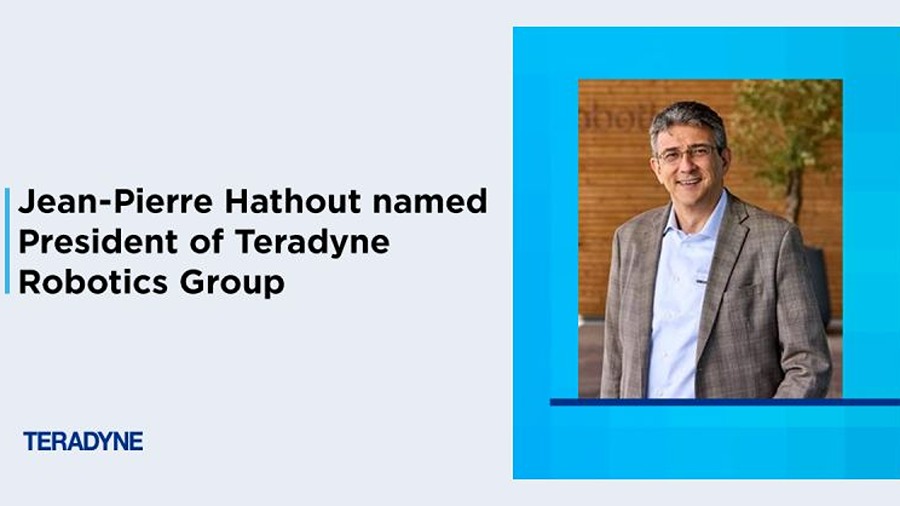
NORTH READING, MA, Sep 5, 2025 – Teradyne has named Jean-Pierre “JP” Hathout as president of the Teradyne Robotics Group, succeeding Ujjwal Kumar. Hathout was appointed president of Universal Robots in May and was previously president of Mobile Industrial Robotics (MiR).
Hathout has more than 20 years of international management experience, including 17 years at Bosch. Most recently, he led MiR, where he strengthened the company’s product portfolio and global position. In his new role, he will continue to lead Universal Robots.
“We are thrilled for JP to step into this new role of leading the Robotics group,” said Greg Smith, president and CEO of Teradyne. “The robotics industry is fast-changing, and I am confident in JP’s ability to navigate the challenges and lead Teradyne Robotics to achieve its growth goals in the years to come.”
“I’m excited to be able to step into this role where I can combine my experience of and passion for both cobot and AMR automation,” said JP Hathout. “This is a further opportunity to leverage the significant technical and commercial synergies between the two brands at a time of rapid innovation and growing market potential.”
Source: Teradyne
About Teradyne Robotics

Teradyne Robotics, a division of Teradyne Inc., develops collaborative and mobile robotic systems for industrial and commercial use. The business includes Universal Robots, which has produced collaborative robots since 2008 for sectors such as automotive, electronics, pharmaceuticals, food and beverage, and metalworking, and Mobile Industrial Robots, which makes autonomous mobile robots for material handling with payload capacities ranging from about 250 kilograms to 1,350 kilograms. Customers include manufacturers, logistics providers, technology firms, and healthcare organizations. Teradyne, founded in 1960 and based in North Reading, MA, reported about $365M in robotics revenue in 2024, with Universal Robots contributing about $293M and Mobile Industrial Robots about $72M. The company positions its robotics offerings as tools to improve productivity, safety, and product quality by pairing human labor with automation.
