

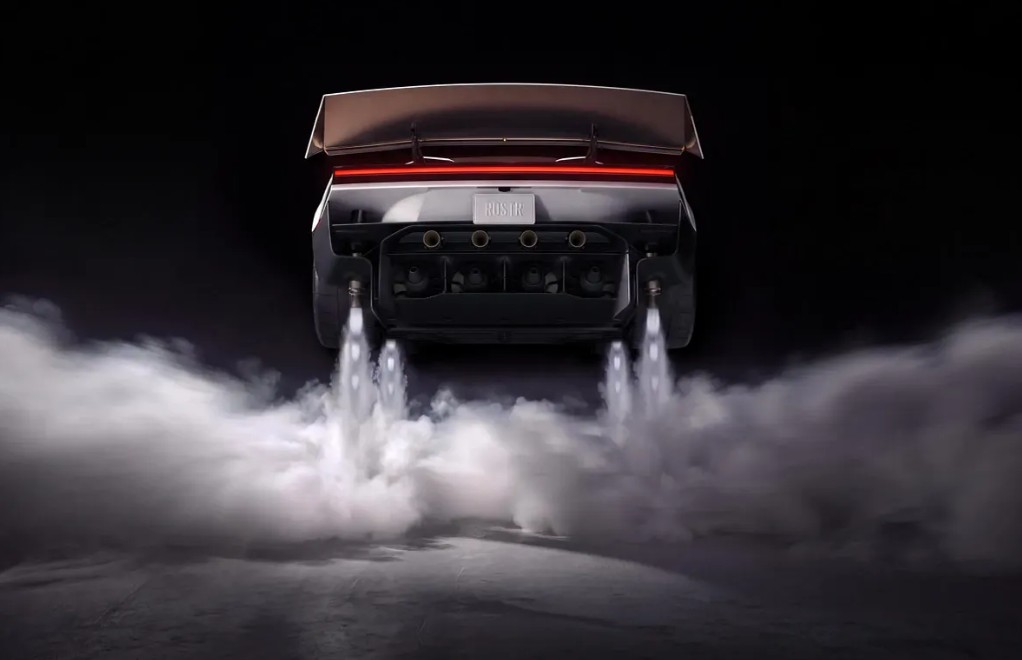
Flying cars present an engineering contradiction. Road vehicles are designed to minimize lift, while performance cars deliberately generate downforce to increase tire grip. Aircraft work in the opposite direction, producing enough lift to overcome their weight. Hardware FYI examines Tesla’s new Roadster rocket variant as an unusual attempt to reconcile these competing requirements.
The Roadster combines two key technologies: fan-based suction and cold-gas thrusters. For its upside-down ramp demonstration, four underbody fans work with deployable skirts to create a low-pressure region beneath the vehicle. The resulting suction generates enough downforce to hold the roughly 1,700-kilogram car against the ramp.
The concept has precedents. Earlier race cars such as the Chaparral 2J and Brabham BT46B experimented with fan-generated downforce, while McMurtry’s Spéirling demonstrated the technology more recently. Tesla’s patented approach uses different operating modes, including a fully sealed configuration for launches and low-speed cornering and a partially sealed mode intended for higher speeds and rough surfaces.
The Roadster’s more unusual feature is its cold-gas propulsion system. Nitrogen stored at approximately 10,000 psi in composite overwrapped pressure vessels, or COPVs, feeds the thrusters. The Thrust model uses a 200-liter vessel, while the Rocket variant adds a 400-liter tank and six additional thrusters. These are positioned to provide lift and yaw control.
High-pressure composite tanks are not unprecedented in automobiles. The Toyota Mirai has used carbon-fiber-wrapped hydrogen tanks at similar pressures. The difference is discharge rate. A Mirai consumes hydrogen gradually, while the Roadster releases nitrogen within seconds, requiring extremely high flow rates.
Hardware FYI ultimately presents the Roadster less as a practical transportation concept and more as an engineering experiment. Its significance lies in combining technologies from motorsports, aerospace, and pressure-vessel engineering to test what an automobile can physically accomplish.
