

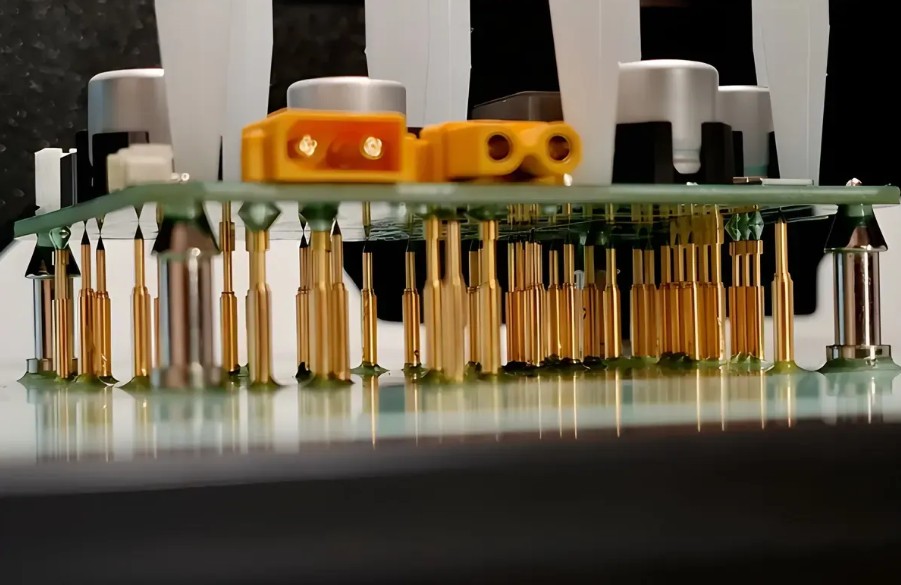
An article from Hardware FYI explores the enduring importance of bed-of-nails testing systems in modern electronics manufacturing. Although semiconductor fabrication and PCB assembly have become increasingly automated and sophisticated, the process of verifying that every board functions correctly still depends heavily on physical testing infrastructure that is often invisible outside manufacturing environments.
A bed-of-nails tester uses an array of spring-loaded probes that make electrical contact with designated test points on a printed circuit board. Once connected, the system can rapidly check continuity, voltages, shorts, component placement, and signal integrity across the board. The article explains that despite advances in software simulation and automated inspection, direct electrical testing remains one of the most reliable ways to detect manufacturing defects before products are shipped.
The challenge is that nearly every PCB design requires its own custom test fixture. Engineers must create highly specific mechanical and electrical setups tailored to the layout of each board, including probe placement, alignment tolerances, and access to test points. This introduces additional engineering effort, cost, and production planning that many outside the hardware industry rarely consider.
The article also highlights a broader tension within electronics manufacturing. Modern devices are becoming smaller, denser, and more complex, leaving less physical space for accessible test points. Designers often prioritize compactness, aesthetics, and cost reduction, sometimes making downstream testing significantly harder. As a result, manufacturing engineers must balance product design goals against the practical realities of production verification.
Beyond technical details, the article frames testing as a hidden but essential layer of industrial reliability. Consumers typically experience electronics as polished finished products, yet behind every smartphone, router, or embedded system lies a large ecosystem of fixtures, diagnostics, and validation procedures designed to catch failures before they reach the market.
The article ultimately argues that bed-of-nails systems represent an overlooked form of manufacturing infrastructure, one that quietly sustains quality control across the electronics industry even as hardware design and production technologies continue to evolve rapidly.
