

Artificial intelligence (AI) is opening new possibilities for computer-aided design (CAD), but generating production-ready geometry directly from natural language remains challenging. In an interview with Machine Design, Darren Henry, senior vice president of general operations at PTC, discusses why code generation could provide an important foundation for future CAD automation.
Current text-to-CAD technologies struggle with complex geometry, repeatability, sketch constraints, and feature dependencies. Their probabilistic outputs can undermine the precision required in engineering applications. Direct modeling also remains preferable for straightforward tasks, while AI could assist with conceptual exploration and simulation preparation.
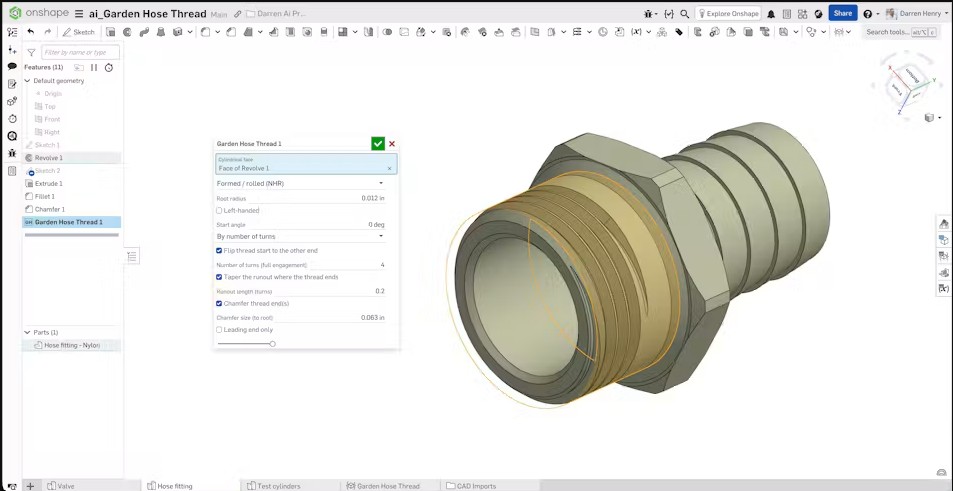
PTC’s Onshape FeatureScript MCP Server offers an alternative by enabling engineers to generate programmable modeling features through natural language instructions. The approach makes CAD customization more accessible to professionals without extensive coding expertise while delivering repeatable geometric results.
Manufacturers can develop reusable tools that accommodate product variations and incorporate established manufacturing practices. These capabilities also introduce intellectual property considerations, particularly regarding the confidentiality of engineering information submitted to AI platforms. Organizations must carefully evaluate differences between individual and enterprise data protection agreements.
Looking ahead, Henry anticipates AI agents that execute sequences of modeling operations, modify material assignments, and calculate assembly costs and weights. Nevertheless, engineers will remain responsible for validating and refining generated designs within established production environments.
For engineering professionals, the discussion raises broader questions about which design activities benefit most from automation and which require direct human involvement. Familiarity with model construction remains valuable when evaluating design changes and their downstream consequences.
As AI assumes greater responsibility for routine modeling, engineers may increasingly focus on manufacturability, production economics, product performance, and customer requirements. The article suggests that the future of CAD will involve collaboration between intelligent software and engineering professionals rather than the wholesale replacement of conventional modeling interfaces.
