

The global artificial intelligence boom is reshaping the semiconductor industry and creating a new generation of technology winners, particularly in Taiwan and South Korea. As major technology companies invest hundreds of billions of dollars in AI data centers, demand for the chips, memory, power systems, cooling technologies, and networking equipment that support AI computing is far outpacing supply, tells The New York Times (full article available to subscribers).
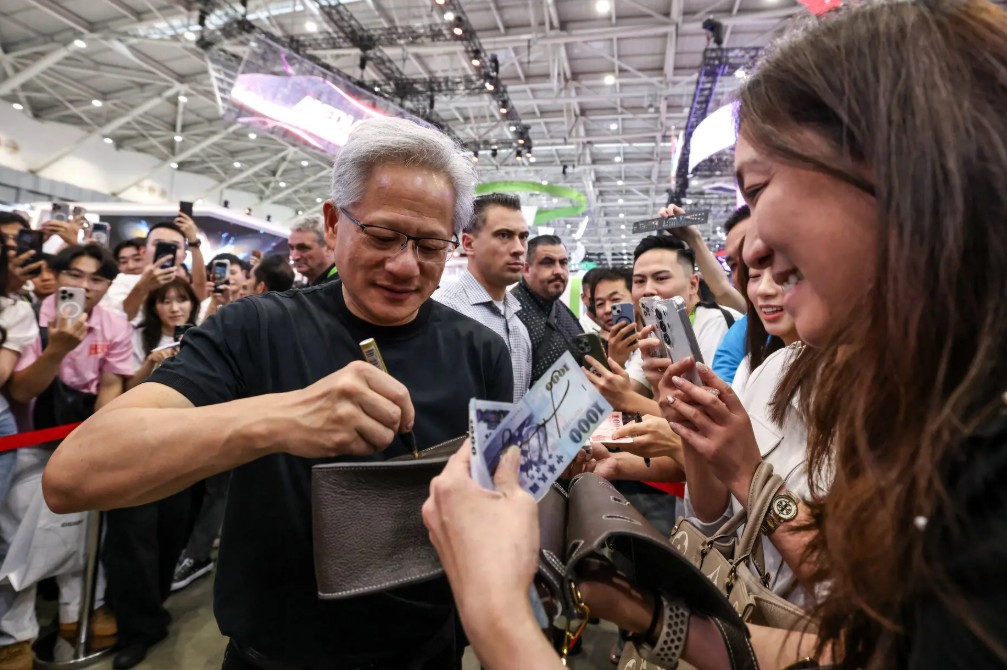
The phenomenon was on full display at Computex in Taipei, where Nvidia CEO Jensen Huang attracted crowds more commonly associated with celebrities than technology executives. His playful request for supplier SK Hynix to “make more” memory chips reflected a serious challenge facing the industry: shortages of the advanced memory required by AI systems.
While Nvidia has become the most visible beneficiary of the AI boom, the article argues that many lesser-known companies are equally critical. Advanced AI models require vast amounts of high-bandwidth memory to store and process data, making memory technology nearly as important as computing power itself. The market for this premium memory is dominated by South Korea’s SK Hynix and Samsung, along with Micron Technology, whose most advanced manufacturing facilities are located in Taiwan.
The resulting supply constraints have driven memory prices sharply higher and fueled remarkable financial gains. South Korea’s stock market has surged, while companies such as Samsung, SK Hynix, and Micron have reached unprecedented valuations. The prosperity extends beyond memory suppliers to server manufacturers, cooling specialists, and power infrastructure providers such as Foxconn, Quanta, and Delta Electronics.
The boom is also altering geopolitical dynamics. Despite years of investment, China remains largely excluded from the most advanced AI supply chains because of U.S. technology restrictions and trade policies. Instead, Taiwan and South Korea have become indispensable hubs for AI infrastructure.
Yet the success carries risks. The global AI supply chain remains concentrated in regions facing geopolitical tensions, and memories of previous semiconductor booms and busts remain fresh. Even so, investors, engineers, and entrepreneurs continue to pour resources into the sector, convinced that AI infrastructure will remain one of the world’s most important growth markets for years to come.
