

Oleg Shilovitsky’s article examines a growing paradox in Product Lifecycle Management (PLM): many organizations appear to be embracing artificial intelligence, yet their behaviors often prevent meaningful transformation. Rather than focusing on traditional technology skeptics, he argues that the greatest resistance to AI now comes from individuals and companies that publicly support AI while ensuring that little actually changes.
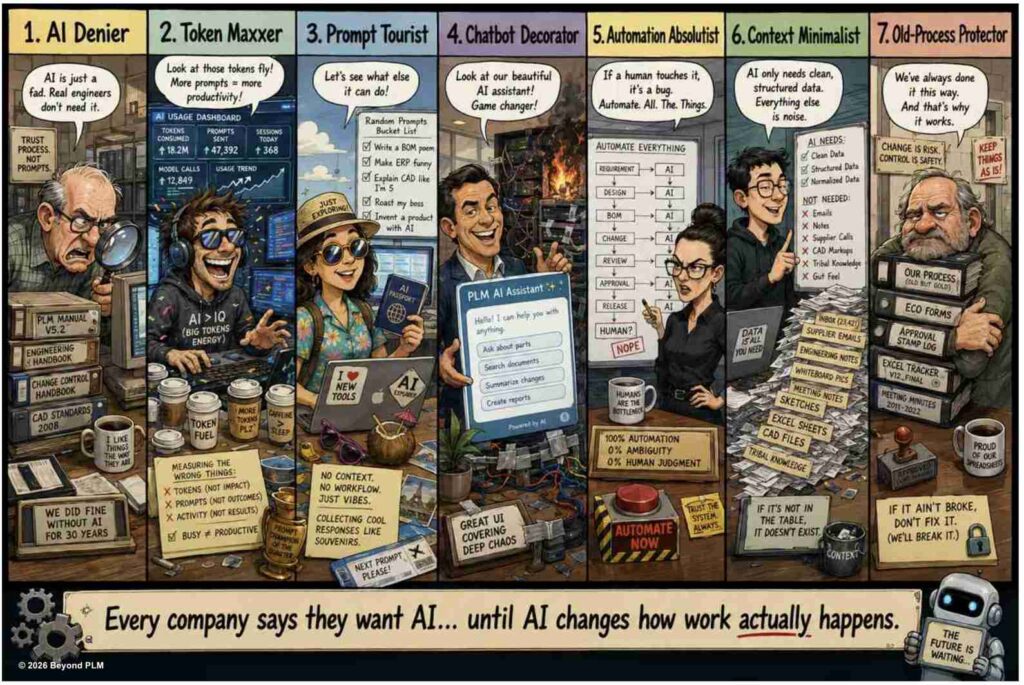
Drawing inspiration from the historical Luddites, Shilovitsky introduces seven modern patterns of AI resistance. The first is the “AI Denier,” who dismisses AI as unsuitable for engineering because of hallucinations, complexity, or specialized product data requirements. While skepticism is understandable in high-stakes engineering environments, outright rejection risks repeating the mistakes organizations made when they resisted cloud-based PLM systems years ago.
The article then explores subtler forms of resistance. The “Tokenmaxxer” measures success through AI usage statistics, token consumption, and chatbot interactions rather than improved engineering outcomes. This can create incentives for employees to maximize activity while delivering little real value. Similarly, the “Prompt Tourist” experiments with AI once, provides minimal context, receives poor results, and concludes that the technology is ineffective.
Other patterns are rooted in technology implementation. The “Chatbot Decorator” adds conversational interfaces to PLM systems without addressing underlying data quality and context problems. The “Automation Absolutist” attempts to replace human judgment entirely, overlooking the need for accountability in engineering decisions. The “Context Minimalist” expects AI to reason effectively without access to product history, constraints, and organizational knowledge. Finally, the “Old-Process Protector” inserts AI into existing workflows without redesigning processes to take advantage of new capabilities.
A key message throughout the article is that AI adoption should be judged by outcomes, not activity. Faster engineering change orders, fewer bill-of-material errors, better decisions, and improved knowledge reuse are meaningful measures of success. Organizations that focus solely on usage metrics, feature announcements, or pilot programs may appear innovative while preserving outdated ways of working.
Shilovitsky concludes that the future winners in PLM will not be those that simply deploy AI tools. They will be the companies willing to rethink workflows, preserve product context, maintain human accountability, and redesign decision-making processes around the strengths of both humans and AI. The real divide is no longer between adopters and skeptics, but between those pursuing genuine transformation and those settling for the appearance of it.
