

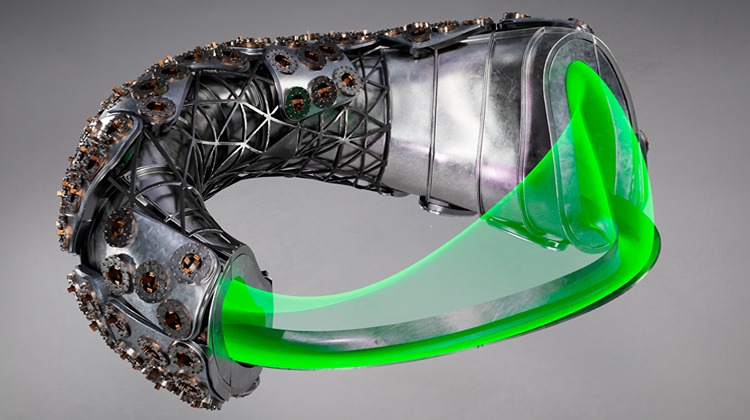
KEARNY, NJ, June 10, 2026 – Thea Energy is developing a digital twin for its Helios fusion power plant with NVIDIA, Synopsys, Argonne National Laboratory and Princeton Plasma Physics Laboratory, using AI, computational models and operational data to support plant design, system analysis and performance testing.
The project connects with the U.S. Department of Energy’s Genesis Mission, which applies AI to scientific and energy research. The mission includes work on baseload fusion power and technical challenges identified in the DOE’s Fusion Science and Technology Roadmap. Thea Energy plans to use AI to connect simulation results with real-world operating data. The company said the workflow could reduce capital needs compared with traditional modeling methods.
“This is a critical public-private collaboration, where Thea Energy is leveraging AI to build systems on time and on budget, keeping us on track to delivering on-demand, abundant fusion power by 2035,” said David Gates, Ph.D., co-founder and chief technology officer of Thea Energy. “Our planar coil stellarator architecture also utilizes AI for its software controls to continuously reoptimize the system and correct for wear-and-tear. With this collaboration, we are expanding our AI applications to include multifaceted device modeling at the click of a button. With the Helios digital twin, we can shorten development cycles and essentially run the system before we even put a shovel in the ground. We are committed to expanding this ecosystem further with partners that share our vision for building the most reliable, scalable, and maintainable fusion power plants.”
Through these collaborations:
- NVIDIA will integrate Thea Energy’s models, codes and real-world data into a digital twin using NVIDIA Omniverse NVIDIA AI infrastructure will support plant performance analysis across large datasets.
- Synopsys will provide simulation software for a unified multiphysics framework. The Ansys simulation-driven, AI-supported workflow will evaluate Thea Energy’s breeding blanket system, which converts fusion energy and protects magnet systems.
- ANL will contribute neutronics analysis, blanket design expertise and data for the Helios digital twin. The work will help address engineering data needs for commercial blanket systems and energy conversion.
- PPPL will provide plasma modeling knowledge and computational tools. Its high-fidelity codes will simulate complex plasma behavior under power-plant-relevant conditions.
John Josephakis, global vice president of HPC and Supercomputing at NVIDIA, added, “AI and accelerated computing are helping scientists and engineers bring complex simulations, operational data and 3D visualization into shared digital twins that can improve how next-generation energy systems are designed. Thea Energy’s Helios work is a strong example, using GPU-accelerated AI with OpenUSD and NVIDIA Omniverse to help bring fusion plant data and simulation results into an interactive environment for faster design exploration and decision-making.”
Steve Pytel, senior vice president of product management at Synopsys, added, “We are developing the Helios digital twin to be more than a model. It will be an analytical tool with the potential to further derisk Thea Energy’s path to fusion on the grid. Our high-fidelity simulation solutions reveal complex interactions with photorealistic detail, enabling engineers to predict behavior and evaluate system performance. These insights play a vital role in optimizing Helios for continuous and reliable energy generation.”
John Tramm, Ph.D., computational scientist at ANL, added, “By launching a high-speed simulation platform, powered by advanced GPU acceleration, we are streamlining neutronics data analysis. With Thea Energy, we look to bridge the gap between large-scale physics simulations and practical engineering iteration and for the first time, complex datasets required to train AI surrogate models on real-world blanket design challenges can feed into the Helios digital twin and provide rapid feedback. This process fundamentally alters the workflow for major power plant components, accelerating the deployment of fusion energy.”
Nate Ferraro, Ph.D., deputy head of PPPL’s theory department, added, “PPPL is using AI to accelerate research and through public-private collaborations with industry leaders, we can help to eliminate uncertainty on the path to commercially viable fusion power. We’re integrating the ‘brain’ into the Helios digital twin by supplying industry leading expertise alongside plasma simulation codes and verified data sets. These data sets will train an extremely high-fidelity surrogate model for Thea Energy that informs the Helios digital twin.”
Thea Energy plans to operate Helios in the 2030s after “Eos”, its demonstration system which will create power-plant-relevant fusion. Eos will benefit from Helios design, including its digital twin.
Source: Thea Energy
About Thea Energy
Thea Energy is a fusion energy company based in Kearny, New Jersey. Founded in 2022, the company develops stellarator systems that use planar superconducting magnet arrays and software controls. Its work includes Eos, an integrated stellarator designed to produce fusion neutrons, and Helios, its planned fusion power plant concept. The company spun out from Princeton University and Princeton Plasma Physics Laboratory to commercialize stellarator-based fusion. Thea Energy also builds and tests high-field magnet hardware at its Kearny facility. Its engineering work covers magnet manufacturing, system design, plasma modeling and controls. The company has received support through the U.S. Department of Energy’s Milestone-Based Fusion Development Program and six INFUSE awards. It works with national laboratories, universities and industrial partners.
