

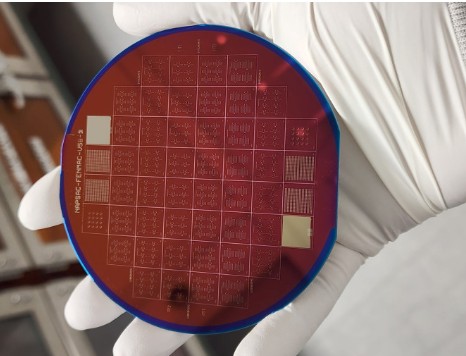
As artificial intelligence workloads continue to expand, researchers are searching for alternatives to conventional computer architectures that consume large amounts of energy, moving data between memory and processing units. A team of Cornell engineers has proposed a different approach: a computing device that stores information electrically but retrieves it through the motion of microscopic vibrating structures.
The research, published in Nano Letters, introduces a ferroelectric nanoelectromechanical system designed for analog in-memory computing and neuromorphic applications. The device combines ferroelectric materials, which can retain analog information without continuous power, with tiny vibrating beams that mechanically read the stored data. This separation of writing and reading functions addresses a common challenge in memory devices, where electrical read operations can disturb or degrade stored information.
Modern computing systems typically keep memory and computation separate, forcing data to move constantly between the two. This data movement consumes significant time and energy, particularly in AI and scientific computing workloads. The Cornell researchers sought to reduce that inefficiency by integrating memory and computation more closely while preserving low power consumption.
The new system, known as FeMEMS, merges ferroelectric memory with nanoelectromechanical devices. Information is written electrically and stored as analog states within the ferroelectric material. Instead of relying on conventional electrical sensing, the stored information is retrieved through mechanical vibrations in nanoscale beams. This method minimizes electrical interference during read operations and helps maintain data integrity.
The prototype chip consists of multiple FeMEMS devices arranged in an array capable of performing multiply-and-accumulate operations, which are fundamental to neural network processing. Because these calculations occur where data is stored, the design reduces the need for energy-intensive data transfers. The architecture also offers nonvolatile memory capabilities, allowing information to remain stored even when power is removed.
Although still in the experimental stage, the technology demonstrates a novel path for AI hardware design. By incorporating nanoscale mechanical motion into computing processes, the Cornell team has shown that future AI accelerators may achieve greater energy efficiency while supporting increasingly demanding machine-learning workloads. The work highlights the growing interest in rethinking computing architectures as AI applications continue to scale.
