

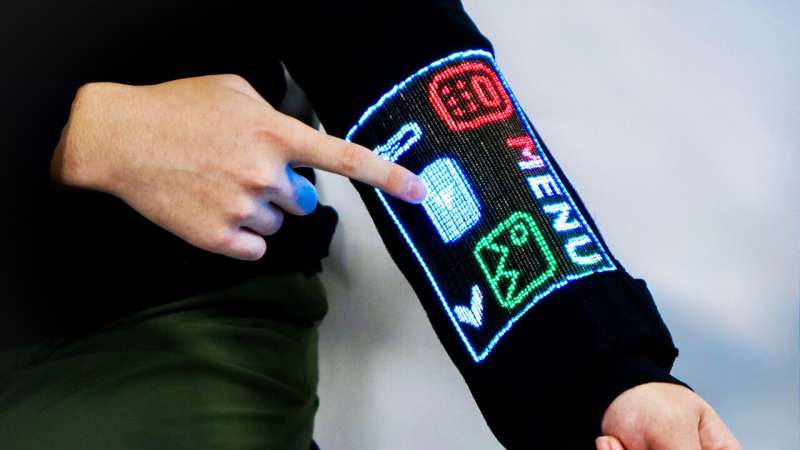
Researchers at the National University of Singapore have developed an electronic fiber that works simultaneously as a display pixel and touch sensor, enabling them to build a touchscreen directly into a garment. The technology could eventually transform clothing into an interactive interface for digital devices, sensing, and health monitoring, tells Tech Xplore.
The team integrated 54 pixel fibers into a sleeve, creating a 96 × 54-pixel display measuring 168 × 105 millimeters. The screen supports 8-bit color and refreshes at 30 frames per second. It can display images and videos, recognize multiple touches, and communicate wirelessly with other devices.
Creating complex electronics inside a thin fiber required a new manufacturing approach. Researchers developed a programmable method for connecting thousands of microelectronic components along insulated wires. Lasers expose precise connection points, while controlled surface wetting directs molten solder to the required locations. This process enabled more than 5,000 chips and 20,000 electrical connections to be incorporated into the system.
The interconnected LEDs were then incorporated into multilayer fibers using thermal drawing. Each fiber is approximately one millimeter thick and can extend 10 meters. A touch-sensitive layer beneath the LEDs detects where a user presses the material.
Additional electronic fibers provide a microphone, speaker, motion sensing, compass functionality, temperature measurement, and ambient-light detection. Together, these components allow the garment to perform functions associated with early smartphones, including running a calculator, displaying photos and videos, responding to voice commands, receiving images through Bluetooth, and measuring body temperature.
Durability tests showed little change in light output or touch sensitivity after 50 machine washes and 1,000 bending cycles. The textile also remained breathable.
Researchers now plan to increase display resolution and integrate additional sensing and on-device AI. The longer-term goal is clothing that can monitor its wearer and surroundings while providing information and interaction directly through the fabric.
