

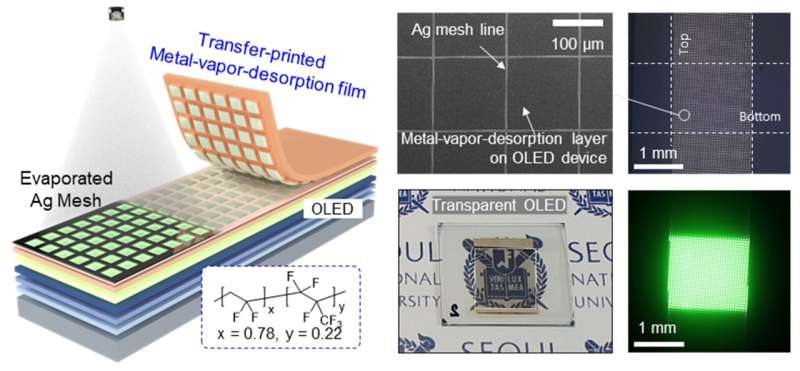
Researchers at Seoul National University have developed a high-performance transparent organic light-emitting diode (OLED) that could advance applications ranging from augmented reality displays to smart windows and automotive interfaces, tells Tech Xplore. Led by Professor Yongtaek Hong of the Department of Electrical and Computer Engineering, the team created transparent OLEDs incorporating highly conductive metal mesh top electrodes fabricated through a novel selective metal deposition process. The work was published in Materials Horizons and was selected as the journal’s outside front cover image.
Transparent OLEDs are considered a key technology for next-generation display systems because they can emit light in both directions while allowing users to see through the device. However, producing transparent electrodes that combine high optical transparency with strong electrical performance remains challenging. Conventional fabrication methods often involve chemical treatments or lift-off processes that can damage the delicate organic layers within OLED devices, limiting performance and manufacturing flexibility.
To overcome these limitations, the researchers developed a metal-patterning approach based on a high-resolution transfer-printing process using a metal-vapor-desorption layer (MVDL). The technique enables direct formation of transparent metal mesh electrodes with micrometer-scale precision while eliminating the need for chemical washing or lift-off steps. This reduces the risk of damaging the underlying organic materials and allows high-quality metal patterns to be deposited directly onto organic device stacks.
The resulting electrodes demonstrated an exceptional combination of transparency and conductivity. They achieved optical transparency ranging from 93% to 99% while maintaining low sheet resistance between 1.1 and 4.0 Ω/sq. The electrodes also delivered a figure of merit exceeding 10,000, one of the highest values reported for transparent electrodes thinner than one micrometer.
The team successfully integrated the metal mesh electrodes into transparent OLED devices, which exhibited strong electroluminescent performance and maintained the integrity of the underlying organic layers. Because the process is compatible with conventional vacuum thermal evaporation and supports high-resolution patterning, it offers a scalable manufacturing route for future transparent displays, flexible optoelectronics, and emerging technologies such as facial-recognition panels. The research presents a promising electrode platform for the next generation of transparent electronic devices.
