

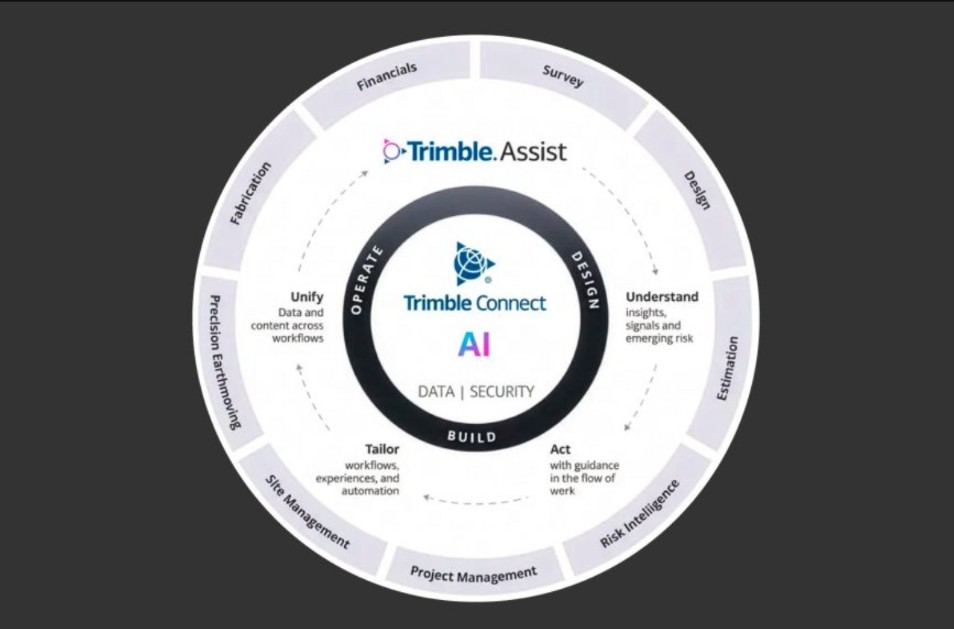
Trimble is expanding artificial intelligence across architecture, engineering, construction, and operations (AECO), introducing AI agents and automation capabilities designed to improve project coordination, reduce risks, and streamline workflows, tells AEC Magazine.
Announced at the Trimble Dimensions User Conference, the new capabilities extend Trimble Connect beyond its traditional role as a common data environment (CDE). The platform now connects design information, construction activities, financial processes, and operational data through an integrated AI layer.
For architects and engineers, AI can generate architectural design options using live as-built point-cloud data. Natural-language prompts can produce constructible structural models, while automated point-cloud classification identifies structural elements from scanned environments.
Construction teams gain AI-powered diagnostics for machine-control systems and tools that convert 360-degree site videos into 3D point clouds. Voice-enabled inspections can transcribe observations and associate them with relevant project drawings, reducing manual documentation.
In project management, AI supports procurement and invoice matching, contract risk assessment, and change-order automation. Intelligent scheduling connects project timelines with live site information to identify potential delays, recommend corrective actions, and update schedules.
Two technologies underpin these capabilities: Trimble Assist and Trimble Agent Studio.
Trimble Assist provides a conversational interface for interacting with AI agents and retrieving insights across Trimble applications. Trimble Agent Studio enables organizations to develop customized agents using established operating procedures and experienced employees’ knowledge. These agents can automate specialized tasks while preserving institutional expertise.
Unlike general-purpose AI assistants, Trimble’s approach combines generative AI models with project-specific information, machine telemetry, and construction industry knowledge. The platform also allows users and developers to configure, coordinate, and govern agents across workflows.
Trimble identifies five major sources of construction risk: physical, informational, contractual, commercial, and knowledge-related.
By connecting these areas through AI, the company aims to improve project predictability, minimize costly disruptions, and support faster decisions. Human judgment remains central, with AI assisting rather than replacing engineering and construction professionals.
