

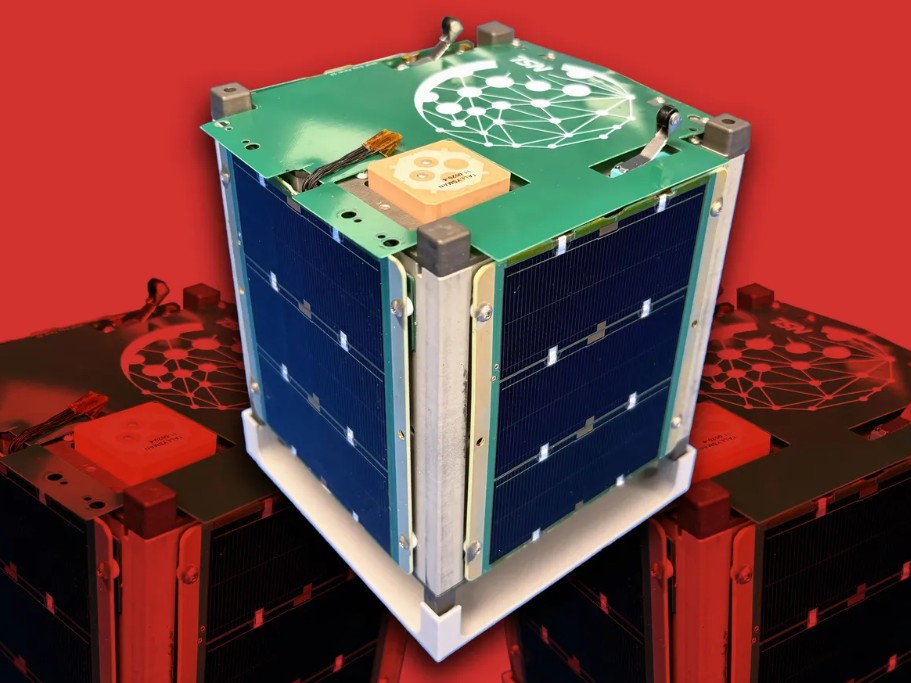
A new type of nuclear battery is undergoing its first test in space, offering a potential source of long-lasting power for future lunar infrastructure. Florida-based City Labs has deployed tritium-powered betavoltaic cells aboard its BOHR CubeSat to determine whether the technology can reliably generate electricity in the harsh space environment, tells IEEE Spectrum.
Launched July 7 aboard SpaceX’s Transporter 17 mission, the 10-centimeter BOHR CubeSat carries 48 tritium batteries on four electronic boards. The satellite itself relies on solar panels, while the nuclear cells power sensors that monitor spacecraft health. Together, the cells produce about 5 microwatts.
The batteries generate electricity from the natural radioactive decay of tritium, an isotope of hydrogen. As tritium decays, it releases beta particles, which strike silicon semiconductor layers and generate an electric field. The process resembles a solar cell, except it converts beta radiation rather than sunlight into electricity.
Tritium offers several advantages for space applications. Its beta radiation is less ionizing than the alpha radiation associated with plutonium, and tritium is easier to produce. The batteries can also operate across extreme temperatures, from about -200°C to 150°C or higher.
Their low output means they are not intended to replace plutonium power systems capable of producing tens or hundreds of watts. Instead, City Labs envisions thousands of small betavoltaic cells powering distributed lunar sensors and other low-energy devices. With tritium’s 12.3-year half-life, the batteries could operate for decades, including through two-week lunar nights and inside permanently shadowed craters.
The BOHR mission could operate for up to 10 years. Future applications may include heating lunar rovers and powering medical implants such as pacemakers, extending the technology well beyond spacecraft.
