

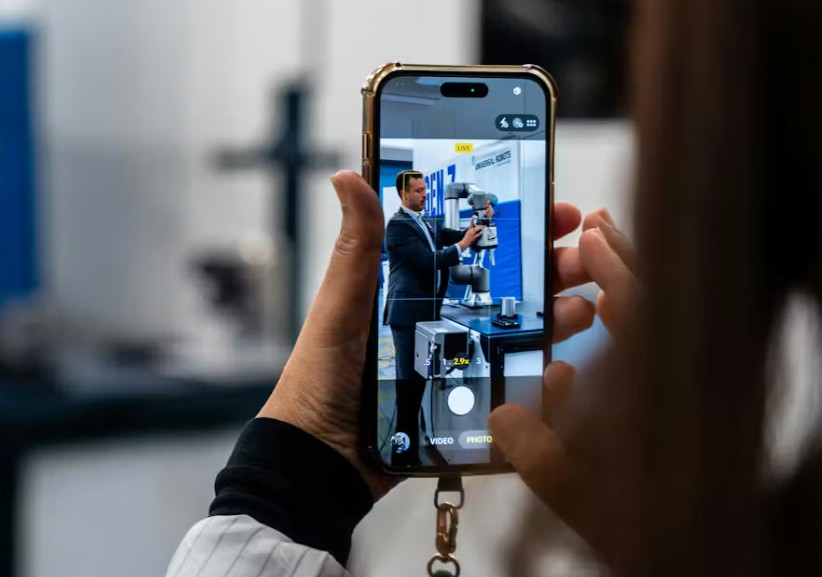
Universal Robots has introduced Gen 7, its seventh-generation collaborative robotics platform, designed to bring AI, sensing, connectivity, and industrial automation closer together. Unveiled at IMTS 2026 in Chicago, the platform represents a ground-up redesign rather than adding AI capabilities to an existing cobot architecture, tells Machine Design.
Gen 7 includes three g-Series robot arms, the CB7 Core controller, TP7 Core teach pendant, SP7 Smart Panel, a redesigned tool flange, and PolyScope X software. The new UR10g-1750, UR17g-1300, and UR18g-950 model names incorporate payload and reach, making key specifications easier to identify.
A major change is connectivity at the robot tool. The redesigned flange supplies Ethernet, power, and configurable I/O, allowing cameras, sensors, and other intelligent end-of-arm devices to connect closer to the work. Integrated force-torque sensing, impedance control, and Real-Time Data Exchange support applications including dexterous manipulation and force-sensitive assembly.
The CB7 Core controller provides 40% more computing power while occupying less space than its predecessor. Three 1-Gb Ethernet ports and configurable I/O support connections with PLCs, HMIs, manufacturing execution systems, industrial PCs, and vision equipment. Universal Robots sees this connectivity as increasingly important as AI brings operational technology and IT infrastructure closer together.
PolyScope X provides Gen 7’s software foundation, offering an open API and built-in ROS 2 communication. This allows developers to integrate external AI processing and industrial computing while maintaining compatibility with the UR+ partner ecosystem.
Universal Robots is positioning Gen 7 for manufacturers that may not use physical AI today but want infrastructure capable of supporting future applications. The TP7 Core is more than 20 percent lighter than earlier versions, while redesigned controls aim to preserve ease of use. Together, these changes turn the robot arm into a connected platform linking motion, sensing, software, computing, and AI on the factory floor.
