

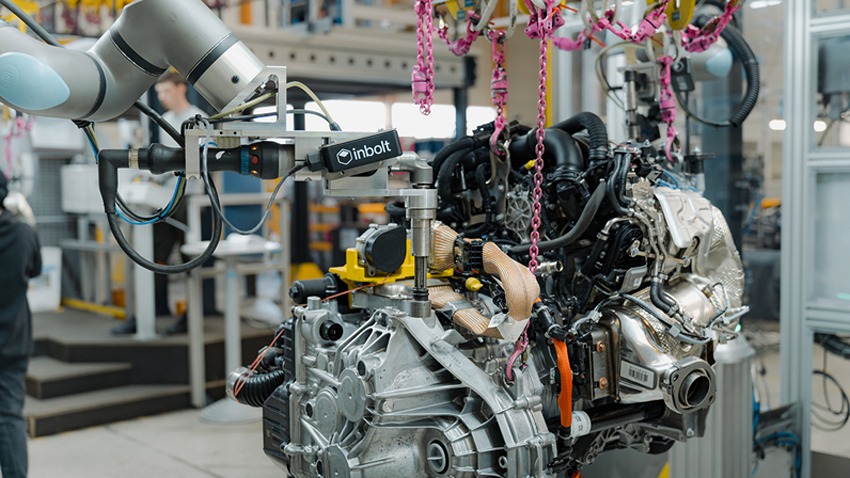
NUREMBERG, Germany, Nov 25, 2026 – Inbolt and Universal Robots (UR), part of Teradyne Robotics, have integrated Inbolt’s 3D AI vision guidance software into UR’s Gen 7 robot platform. Announced at SPS 2026 in Nuremberg, Germany, the integration allows Inbolt Standard to run on the robot’s CB7 Core controller without a separate industrial PC.
Inbolt standard uses a wrist-mounted 3D camera to recognize parts from their CAD files and determine positions. The software adjusts the robot’s taught path to the actual part position during each operating cycle. Applications include screwdriving, machine tending, rack loading and depalletizing.
By adapting robot movements to part positions, the software reduces the need for custom jigs and fixtures at production stations. Manufacturers can adjust robot programs for different parts without modifying tooling for each change.
Inbolt Standard is licensed to run on the CB7 Core controller. Inbolt Studio, which handles part training and station setup, runs as a URCap within PolyScope X. Part localization runs on the controller’s processor, while Inbolt commands appear in the PolyScope X program tree and can be called like URScript instructions.
An Orbbec 3D camera connects to the power connector and ethernet port on the Gen 7 g-series tool flange. Operators can train the system using a part’s CAD file in under 10 minutes, without image datasets or labeling.The companies report repeatability of 0.5 to 0.7 mm on fixed parts. The camera uses infrared depth sensing to operate in bright, dim and dark conditions.
“Gen 7 is our platform for physical AI, giving partners the compute, connectivity and tools to develop AI applications and deploy them directly on the robot,” said Anders Billesø Beck, vice president, AI Robotics Products at Universal Robots. “Inbolt Standard is a clear example of what that brings to the factory floor in terms of usability and reduced integration time. For manufacturers that standardize on UR across many sites, vision guidance is now a standard option for every new cell.”
Industrial Applications
Universal Robots and Inbolt have worked together since 2022, with vision-guided UR robot cells operating in Europe and North America. At a Stellantis engine-tightening station, the companies report that Inbolt guidance reduced tightening failures by 91%, with vision processing taking 0.5 seconds per engine.
Inbolt Standard supports stationary applications involving individual parts, layered racks and trays, including bolt run-down, de-racking and depalletizing. The companies also identify electronics and data center hardware applications involving tray loading, fastening and torquing of enclosures and server chassis. According to Inbolt, a single robot program can switch between more than 80 part references, and users can retrain the system for new parts.
“Inbolt and Universal Robots have deployed vision-guided cobots together for years, and with the new Gen 7, our products have never been closer,” said Rudy Cohen, co-founder and CEO of Inbolt. “Because vision guidance now runs on the robot itself, a manufacturer rolling out cobots across dozens of stations and several plants can specify it on every cell from day one, instead of engineering a new fixture for every part. We’ll bring more of the Inbolt range to UR customers in the coming months.”
Compatibility and Availability
Inbolt Standard runs on UR’s Gen 7 g-series robots, including the UR10g-1750, UR17g-1300 and UR18g-950, with PolyScope X V10.13 or later. The software is also compatible with e-Series and UR series robots equipped with a CB7 controller. These configurations require an external camera cable.
Inbolt Standard is listed on the UR+ marketplace and will soon be available to order through Universal Robots and its partners.
Source: Universal Robots
About Inbolt

Inbolt is an industrial robotics software company founded in 2019 and headquartered in Paris, France. The company develops AI and 3D vision software for guiding industrial robots. Its technology uses cameras and CAD models to identify parts and determine their positions. The software adjusts robot movements when components shift during production. Its products include Inbolt Vision Model, Inbolt Robot Programming and Inbolt Robot Control. Manufacturers use the software for robot programming, inspection, material handling, fastening, adhesive dispensing and component placement. Inbolt serves automotive, electronics, data center equipment and household appliance manufacturers. The software supports existing robotic workstations and new installations on stationary and moving assembly lines. Inbolt operates in Europe, the United States and Japan. Inbolt reports deployments in more than 100 factories worldwide.
About Universal Robots
Universal Robots, founded in 2005 in Odense, Denmark, is a manufacturer of collaborative robots (cobots) designed to work alongside humans in industrial settings. The company offers a range of robotic arms, including the UR3e, UR5e, UR10e, UR16e, UR20, and UR30 models, each tailored for tasks such as assembly, machine tending, packaging, and quality inspection. The cobots are utilized across industries, including automotive, electronics, metal fabrication, and healthcare. The company employs over 1,000 people globally and has expanded its footprint with offices in over 20 countries.
