

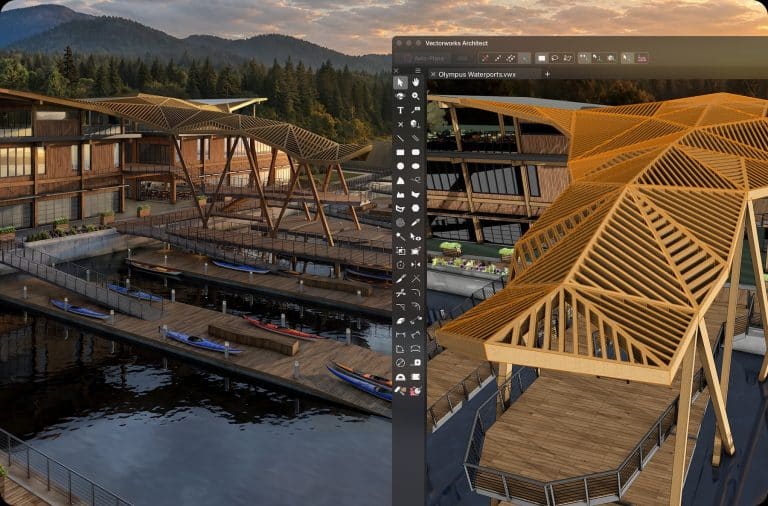
Vectorworks 2027 introduces significant improvements in visualization, graphics performance, and building information modeling (BIM), strengthening its hybrid CAD/BIM capabilities. The latest release emphasizes faster workflows, improved interoperability, and easier access to reusable design resources, tells Architosh.
A major advancement is the modernized Vectorworks Graphics Module, which uses Apple Metal on macOS and Vulkan on Windows to shift more processing from CPUs to GPUs. According to Vectorworks, certain panning and zooming operations deliver frame-rate improvements of 15–35 times, while multi-object selection can become up to 50 times faster.
Visualization receives attention through an upgraded physically based rendering (PBR) system. A redesigned texture editor provides live previews, while existing textures can be converted into modern PBR materials and transferred to third-party rendering applications.
The AI Visualizer now incorporates Google’s Nano Banana technology, enabling subscribers to generate AI-enhanced architectural imagery. Higher-resolution rendering options include credit tracking to manage usage.
Another addition is The Exchange, a community resource hub offering reusable models, textures, and other design assets. Improved AutoCAD dynamic block support allows imported objects to become editable Vectorworks symbols or consolidated dynamic objects.
For architects, Vectorworks 2027 introduces enhanced door and window modeling, including pivot doors. A new Geolocation Setup Wizard aligns surveys, point clouds, GIS information, and Google Maps imagery while allowing users to switch between geographic and local project coordinates.
A multi-phasing system supports existing conditions, renovations, and as-built documentation. Area calculations can follow DIN 277, NED 2580, SIA 416, or customized standards.
Vectorworks Landmark also gains a Volume Fill tool for quantifying site elements, including retention basins and fill materials.
Rather than introducing an entirely new design paradigm, the release concentrates on performance, visualization, and practical improvements. Its expanded resource ecosystem and interoperability features could help architects reuse existing content more effectively while managing increasingly complex BIM projects.
