

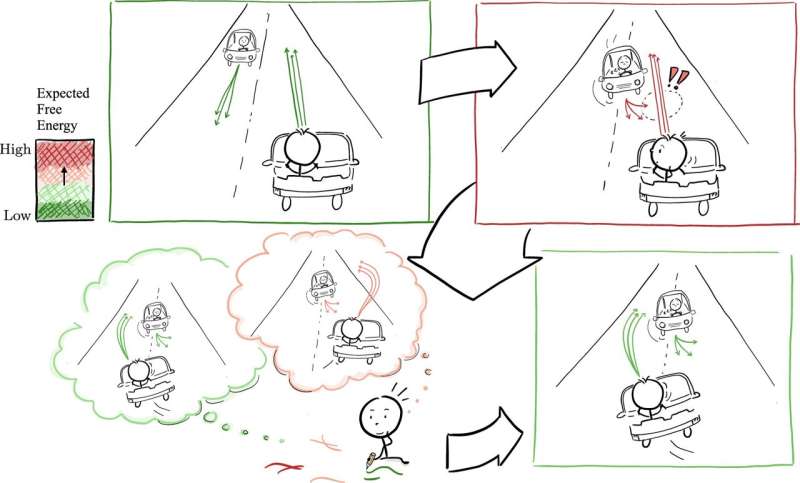
As autonomous vehicles move closer to widespread adoption, ensuring their safety remains one of the industry’s greatest challenges. To improve the evaluation and development of self-driving technology, Waymo has introduced a virtual model of human driving behavior called ReD, or Reference Driver. Developed in collaboration with researchers from Delft University of Technology, the system is designed to simulate how human drivers react in dangerous situations and avoid collisions, tells Tech Xplore.
The research, published in Nature Communications, addresses a limitation of many current testing methods. Existing collision-avoidance assessments often focus on isolated scenarios, such as sudden braking by a lead vehicle, without capturing the complete sequence of perception, decision-making, and action that occurs when a human driver responds to a hazard. Human drivers rely on a complex interaction between the brain and nervous system to recognize threats and react within fractions of a second.
ReD seeks to replicate this process using a neuroscience-based framework known as active inference. This theory models how the brain continuously predicts and interprets events in order to minimize unexpected outcomes. By incorporating these principles, the virtual driver can emulate the way humans assess risks and choose evasive actions in challenging traffic situations.
Researchers describe ReD as a behavioral equivalent of a crash-test dummy. While traditional crash-test dummies measure the consequences of collisions, ReD is designed to evaluate whether collisions can be avoided altogether. Operating entirely within a computer simulation, the model was tested against real-world driving data to determine its accuracy.
The results showed that ReD successfully reproduced human driving behavior in three critical scenarios: sudden braking by a vehicle ahead, an oncoming vehicle unexpectedly entering a lane, and a driver failing to yield at an intersection. These findings suggest that active inference can provide a useful framework for modeling human behavior in complex driving environments.
Although the model remains under development, researchers see it as a promising benchmark for autonomous vehicle testing. Future work will focus on expanding ReD to handle more complex traffic environments and a broader range of real-world driving situations, helping improve the safety and reliability of self-driving systems.
