

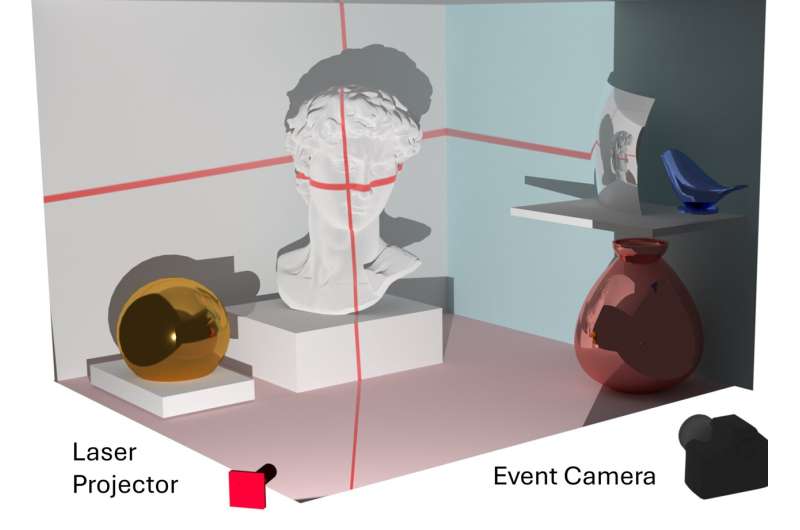
Researchers have developed a new computational imaging technique that enables machines to better interpret three-dimensional environments using virtual screens generated through software rather than physical imaging hardware, tells Tech Xplore. The work could improve how autonomous systems, robots, and advanced sensing technologies perceive complex spaces where visibility is limited or incomplete.
Traditional imaging systems rely heavily on physical camera placement and direct lines of sight. Reconstructing hidden or partially obscured objects in three dimensions is often difficult because sensors cannot easily capture all relevant angles and reflections. The new method addresses this limitation by creating “virtual screens” computationally, allowing machines to infer information about environments that are not fully visible from a single viewpoint.
The researchers demonstrated that the system can improve the reconstruction of complex 3D scenes by analyzing how light interacts with surfaces and by mathematically simulating additional viewpoints. Instead of depending entirely on physical hardware arrangements, the approach uses algorithms to extend the machine’s understanding of spatial information. This allows for a more accurate interpretation of shapes, positions, and hidden structures within an environment.
One important advantage of the technique is flexibility. Because the virtual screens exist computationally, researchers can optimize their placement and behavior dynamically without redesigning physical equipment. That adaptability could prove useful in applications where sensor positioning is constrained, including robotics, autonomous vehicles, medical imaging, industrial inspection, and augmented reality systems.
The research reflects a broader trend in computational imaging, where software increasingly compensates for limitations in physical sensing hardware. Advances in machine learning, mathematical modeling, and light-field analysis are allowing engineers to extract richer environmental information from fewer sensors and smaller devices. In many cases, the intelligence of the imaging system is shifting away from the camera itself and into the algorithms processing incoming data.
As machines become more dependent on accurate spatial awareness, techniques such as virtual screen reconstruction could help improve navigation, interaction, and environmental understanding across a growing range of autonomous technologies.
