

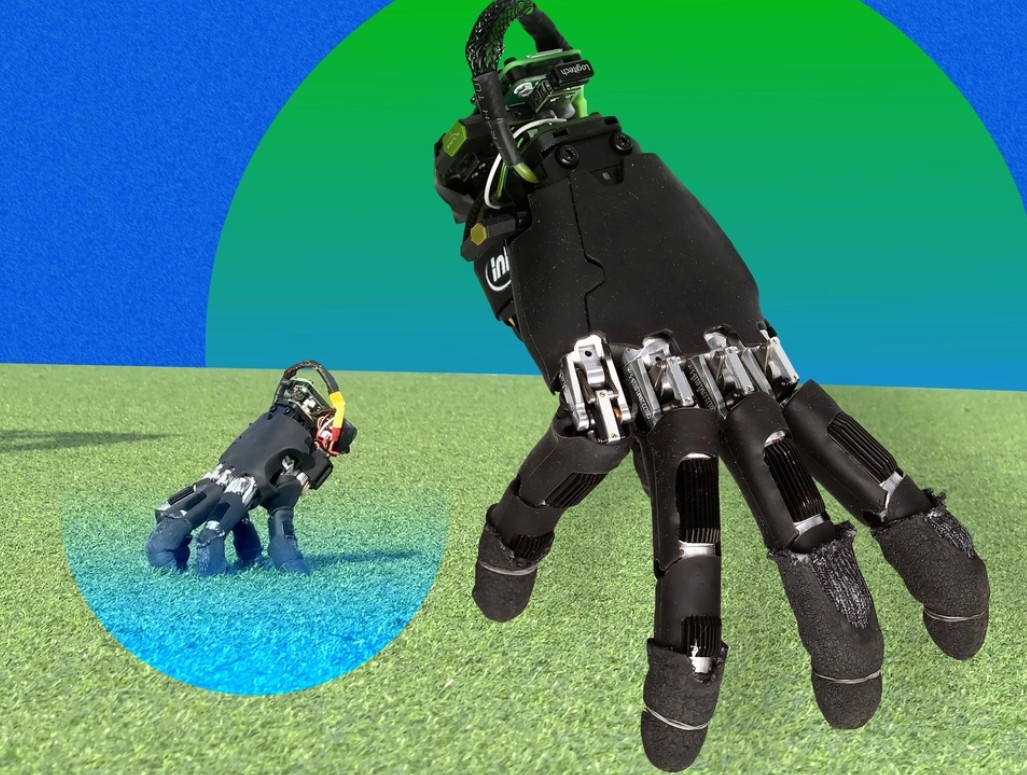
Researchers at ETH Zurich have transformed an off-the-shelf robotic hand into a self-contained mobile robot that can walk on its fingertips while using the same fingers to manipulate its surroundings. The project explores a different approach to robot design, where individual body parts can perform multiple roles rather than remain dedicated to one function, tells IEEE Spectrum.
The team used a commercial hand from Wuji Technology to preserve its existing manipulation abilities. An 80-gram backpack containing a battery, inertial measurement unit, and Raspberry Pi Zero provides the hardware needed for independent operation.
Teaching the hand to walk required reinforcement learning in simulation. Unlike conventional bipedal or quadrupedal robots, a humanlike hand is highly asymmetrical because its fingers differ in length and include an opposable thumb. Researchers therefore established individual target positions for each finger. Virtual spring-like constraints encouraged the fingers to maintain a stable crawling posture while allowing forward and backward movement.
Separate AI models control crawling, self-righting, keyboard pressing, and object pushing. All four models run on the onboard computer, allowing the controller to switch between behaviors.
During physical testing, the hand successfully traveled across 14 surfaces, including smooth flooring, grass, gravel, and metal grates. It reached an average speed of 9 centimeters per second and recovered from falls in 21 of 25 trials. Using video from an overhead camera, it also pushed a 41-gram cube toward targets up to 40 centimeters away in 15 consecutive attempts.
Potential applications include industrial maintenance and search-and-rescue missions, where a detachable hand could enter spaces inaccessible to a complete robot. Researchers envision broader autonomous modular robots whose components can switch between locomotion, support, and manipulation as tasks change.
