

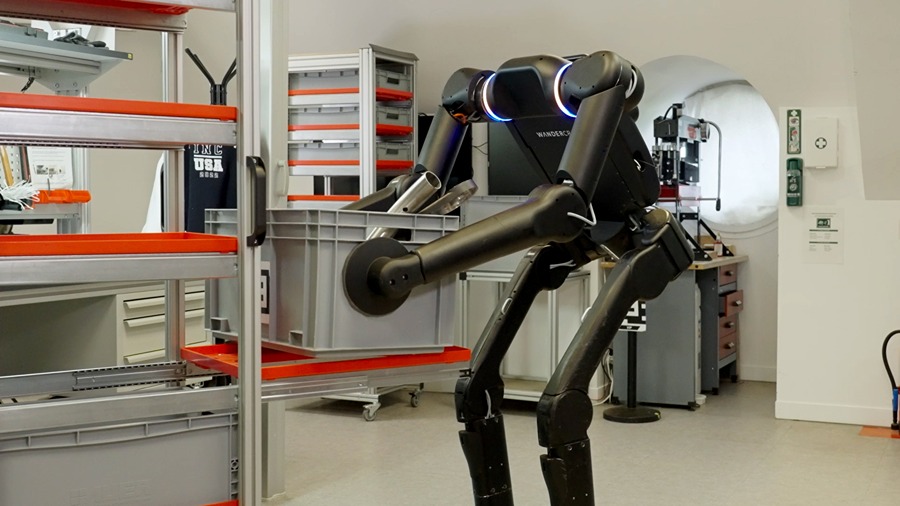
PARIS, France and ARPAIA, Italy, Nov 25, 2025 – Wandercraft and Sapa announced a partnership to deploy and scale the Calvin-40 humanoid robot across Sapa’s industrial operations.
The deployment makes Wandercraft the first robotics company to roll out its humanoid system across both an OEM and a Tier 1 supplier within five months since the robot’s debut. It also makes Sapa the first industrial manufacturer in Italy to include humanoid robotics in its automation plans.
This announcement marks Wandercraft as the first global robotics company to expand its humanoid footprint across an OEM and a Tier 1, with deployments in two countries, within five months of its reveal. It also marks a first for Italy, as SAPA becomes the country’s first industrial manufacturer to commit to humanoid robotics as part of its automation roadmap.
Wandercraft’s partnership with Sapa extends its industrial reach by involving both OEM and Tier 1 suppliers and helps accelerate deployment and operational testing of its humanoid system.
“We don’t believe in building a general-purpose robot and hoping customers figure out how to use it,” said Matthieu Masselin, CEO and co-founder of Wandercraft. “Our strategy is deliberately use-case driven, meaning Calvin-40 is modular by design and will build towards that generalizable future starting from the point of usefulness. Partnering with SAPA fits perfectly into our strategy to first deploy use cases that are valuable across the entire industry and support the full value chain as it evolves toward the future of automation.”
This deployment will support Wandercraft’s development of heavy – payload humanoid systems for manufacturing environments. The first implementation phase will focus on repetitive handling of large, heavy parts, a capability built into the company’s humanoid design.
“SAPA has always stood at the forefront of innovation, not just in manufacturing components, but in driving leadership in industrial automation,” said management team of SAPA Group. “Our recent acquisition of Megatech and this partnership with Wandercraft reinforce that mindset. This is about investing in what’s next – not just in how we manufacture parts, but in how we run the factory itself. We are more motivated than ever to explore humanoid robotics and operational efficiencies that scale across tasks and countries, enabling SAPA to lead the next wave of manufacturing transformation starting right here in Italy.”
The partnership centers on industrial deployment. Wandercraft and Sapa will define use cases that match workflows in high-volume production. Each Calvin-40 deployment will target a specific task and be measured for performance as it expands to additional sites. The approach reflects the idea that humanoid capability develops by mastering focused, high-value jobs.
Europe Championing the Humanoid Race via Wandercraft’s Rapid Industrial Expansion
Wandercraft’s agreement with Sapa, along with its alliance with Renault Group, positions the company among the first in Europe to deploy heavy-payload humanoids across both an OEM and a Tier 1 supplier.
“We’re putting European innovation on the map and solidifying our global dominance in physical AI,” said Masselin. “With over 100 robots in the field taking over 1 million actions per month, we’re building a gigantic dataset of real-world human motion, enabling our teams to push the boundaries of autonomous operation and making artificial intelligence actually intelligent.”
For Sapa, the partnership provides access to humanoid use cases built around production demands. Working with Wandercraft allows Sapa to deploy robots that increase throughput and reduce manual strain. Joining Wandercraft’s manufacturing network, including Renault Group, also gives Sapa tested applications such as heavy-box handling with the Calvin-40 system. This development model positions Sapa to adopt automation faster across the automotive supply chain.
Source: Wandercraft
About Wandercraft

Wandercraft is a French medical robotics company established in 2012 and headquartered in Paris. It focuses on developing self-balancing robotic exoskeletons to improve mobility for individuals with severe disabilities. Its primary clinical product, Atalante X, is used in rehabilitation centers, while the personal exoskeleton Eve is designed for home and outdoor use. The company has secured substantial funding, including a $75 million Series D round in 2025, to support technology development and commercialization. Wandercraft operates internationally, with a U.S. office in New York City and products deployed in over 100 rehabilitation centers across Europe and North America. The company holds more than 30 patents and maintains over 100 Atalante units in hospitals worldwide. Its exoskeletons generate real-world movement data, which fuels a proprietary neural network driving the next generation of devices, including the humanoid robot Calvin 40. Wandercraft’s work aims to provide reliable robotic assistance to those with impaired mobility.
About SAPA

Sapa Group is an Italian Tier 1 automotive supplier founded in 1998 and headquartered in Benevento, in Italy’s Campania region. The company produces lightweight, injection-molded plastic components and uses its proprietary One-Shot method to support fully integrated manufacturing. Sapa supplies interior, exterior, and engine-compartment parts to global automakers and serves both OEMs and Tier 1 suppliers involved in passenger vehicle production. It operates production facilities across Europe and continues to expand its international footprint. Sapa runs 10 manufacturing plants, employs more than 1,700 people worldwide.
