

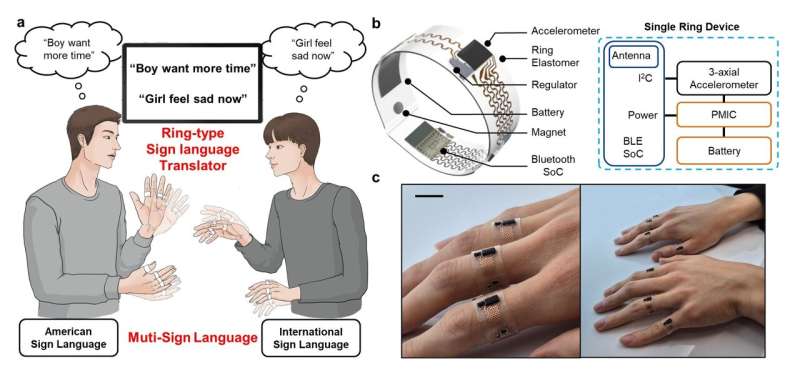
A report from Tech Xplore highlights the development of a smart wearable system designed to translate sign language into spoken words and text almost instantly. Created by researchers working at the intersection of flexible electronics, artificial intelligence, and wearable sensing, the technology aims to reduce communication barriers between deaf individuals and people unfamiliar with sign language.
The system relies on a lightweight glove embedded with flexible sensors capable of detecting detailed finger, hand, and wrist movements. As users perform gestures, the sensors capture motion data that is processed through machine-learning algorithms trained to recognize specific sign language patterns. The translated output is then converted into readable text or synthesized speech in real time.
According to the article, the glove is designed to be more comfortable and practical than earlier sign-language translation systems, many of which depended on bulky hardware, external cameras, or constrained laboratory environments. Researchers focused on making the device portable, responsive, and suitable for daily communication scenarios. The flexible sensors can accurately detect subtle finger bending and movement combinations essential for interpreting sign language with higher precision.
The article notes that the technology still faces important limitations. Sign languages involve far more than hand gestures alone, often incorporating facial expressions, body posture, and contextual nuance that remain difficult for wearable systems to fully interpret. Researchers, therefore, view the glove not as a replacement for human interpreters or sign language fluency, but as a tool that could assist communication in certain environments.
Potential applications extend beyond accessibility. Similar wearable sensing technologies could contribute to robotics control, virtual reality interfaces, rehabilitation systems, and human–machine interaction research. The work reflects a broader trend toward electronics that integrate more naturally with the human body while translating physical movement into digital information.
The project ultimately demonstrates how advances in flexible electronics and AI are beginning to reshape assistive technology. By turning hand movements into immediate digital language, researchers are moving closer to communication systems that feel less mechanical and more conversational, helping bridge gaps between physical gestures and spoken interaction.
