

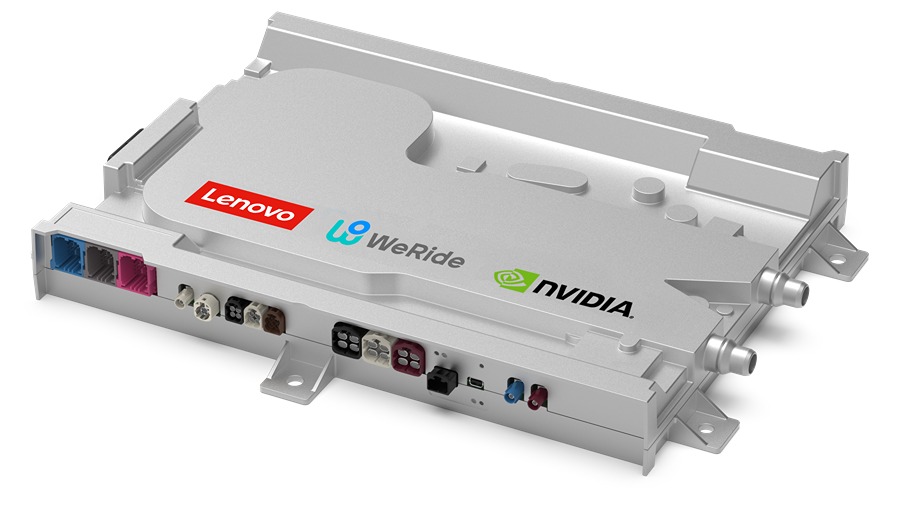
GUANGZHOU, China, July 22, 2025 – WeRide has launched HPC 3.0, a high-performance computing platform developed in collaboration with Lenovo and powered by NVIDIA’s DRIVE AGX Thor. The platform debuts in WeRide’s existing Robotaxi GXR, marking the first time a mass-produced Level 4 autonomous vehicle has been built on NVIDIA DRIVE AGX Thor. Designed to meet automotive-grade standards, HPC 3.0 reduces the cost of the autonomy stack by 50% and supports global deployment across WeRide’s fleet, starting with the GXR.
WeRide’s HPC 3.0 platform, featuring a dual NVIDIA DRIVE AGX Thor configuration running the safety-certified DriveOS, is built on Lenovo’s AD1 L4 autonomous driving domain controller – delivering up to 2,000 TOPS of AI compute. HPC 3.0 improves system integration and lowers mass production costs to 25% of those for HPC 2.0. It reduces the cost of the autonomous driving suite by 50%. The update consolidates key modules, including the ethernet gateway, CAN gateway, inertial navigation, and collision detection, which reduces production and maintenance costs. As a result, HPC 3.0 lowers total cost of ownership by 84% over its lifecycle compared to HPC 2.0.
HPC 3.0 is certified to AEC-Q100, ISO 26262 and IATF 16949 standards. Its design architecture supports ASIL-D safety requirements, with a failure rate of less than 50 FIT(failures per billion hours of operation) and a MTBF (mean time between failures) of 120,000 to 180,000 hours. The system is designed for a lifespan of 10 years or 300,000 km. It can operate in temperatures from -40°C to 85°C and has passed tests for heat, shock, and corrosion. HPC 3.0 complies with global VOCs environmental regulations, making it suitable for deployment across the Middle East, Southeast Asia and Europe. This compatibility supports WeRide’s goal of expanding its Robotaxi fleet globally.
“Our close collaboration with Lenovo and NVIDIA represents a major breakthrough in computing power, system architecture, and cost efficiency. Integrating the HPC 3.0 platform into our Robotaxi GXR enhances vehicle reliability and responsiveness while significantly reducing deployment costs. Moving forward, we plan to extend this platform across more of our L4 autonomous vehicles – including the Robobus, and Robosweeper – bringing smart, accessible mobility to more cities and customers worldwide,” said Tony Han, founder and CEO of WeRide.
“We’re thrilled to see the successful deployment of NVIDIA DRIVE AGX Thor on WeRide’s Robotaxi GXR, marking a significant step towards bringing L4 autonomous vehicles to market at scale. Our close collaboration with WeRide on the AD1 domain controller has been instrumental in accelerating this innovation. Lenovo is committed to leveraging our advanced computing power and working with industry partners to drive the commercialization of autonomous driving solutions globally,” said Donny Tang, vice president and head of Lenovo Vehicle Computing, Lenovo.
“Robotaxis are reshaping urban mobility, and it’s exciting to witness the progress WeRide and Lenovo have made in deploying a Level 4 autonomous driving system built on NVIDIA accelerated compute and DriveOS,” said Ali Kani, vice president of automotive, NVIDIA. “Their achievement marks a significant milestone in helping make safe, scalable, and efficient autonomous transportation a reality.”
NVIDIA DRIVE AGX Thor, NVIDIA’s successor to DRIVE AGX Orin, is built on the NVIDIA Blackwell architecture and is optimized for the most demanding processing workloads, including generative AI, vision language models and large language models. Its simplified architecture enhances generalization, reduces latency and boosts safety by harnessing powerful NVIDIA accelerated computing to run WeRide’s proprietary AV software stack.
As the first publicly listed Robotaxi company, WeRide has operated Robotaxis on public roads for over 2,000 days. The company continues to expand its technology through global partnerships, providing safe and cost-effective autonomous mobility.
Source: WeRide
About WeRide

WeRide, founded in 2017 and headquartered in Guangzhou, China, with a U.S. office in San Jose, develops Level 4 autonomous driving systems. Its portfolio includes robotaxis, robovans and RoboSweepers, supporting applications in ride-hailing, logistics, public transport and urban services. The company operates in China, the United Arab Emirates, Singapore, France and other global markets. WeRide reported revenue of about $49.5M in 2024, with $10M earned in the first quarter of 2025. With a fleet of more than 1,200 autonomous vehicles and a backing that includes a $100M investment from Uber, WeRide is expanding robotaxi operations into 15 new cities. Its platform combines AI-driven sensing, mapping, and software technologies to scale autonomous services across industries.
About NVIDIA

NVIDIA Corporation, based in Santa Clara, CA, is a U.S. technology company specializing in the design and production of graphics processing units (GPUs). Its hardware and software solutions support a range of applications and simulation. Operating for over 30 years, NVIDIA has seen strong financial growth, reporting $39.3 billion in revenue and $22.1 billion in net income for the fiscal quarter ending January 2025. Its headquarters are designed to promote a flat organizational structure that encourages open communication and collaboration between leadership and staff across industries. In gaming, its GPUs power high-performance visual rendering. In artificial intelligence and high-performance computing, NVIDIA provides the infrastructure needed for training and deploying large-scale models. The company also contributes to the automotive sector with systems for autonomous driving and supports robotics with tools for AI-based perception.
About Lenovo

Lenovo Group Limited, founded in 1984, is a multinational tech company specializing in designing, manufacturing, and marketing consumer electronics, personal computers, software, servers, and related services. Serving industries such as education, healthcare, retail, and manufacturing, Lenovo offers a diverse product portfolio that includes laptops, desktops, tablets, smartphones, workstations, servers, storage devices, and accessories. The company markets its products under renowned brands like ThinkPad, ThinkBook, IdeaPad, Yoga, Motorola, and Legion. Headquartered in Beijing, China, and Morrisville, NC, Lenovo operates in over 60 countries and sells its products in approximately 160 countries worldwide. In the fiscal year ending March 2023, Lenovo reported revenues of $61.9 billion, maintaining its position as a global leader in the personal computer market with a 24.4% market share.
