

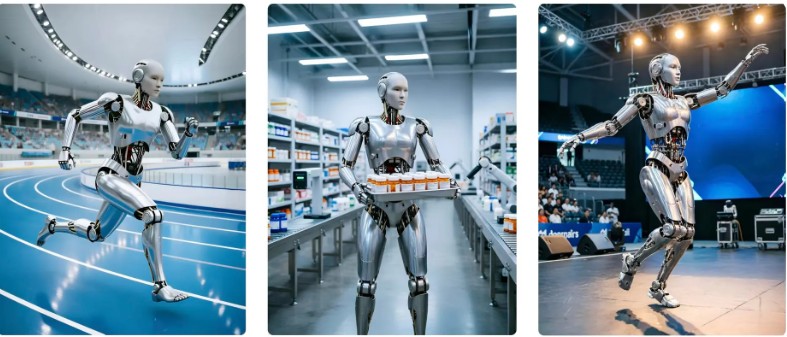
The second World Humanoid Robot Games in Beijing offer more than a showcase of robotic athleticism. According to Forbes, the event program provides a useful snapshot of what humanoid robots can accomplish autonomously and where they could first find commercial applications.
The Games, opening August 22, will feature 2,056 robots and 666 teams from 16 countries and regions. Participants will compete in 1,301 matches over five days. Compared with the previous year, robot participation has increased 311%, while the number of teams has risen 138%. Chinese teams account for 96% of entries.
The 50 events include 30 sports competitions and 20 scenarios modeled on real jobs. Many sporting events require complete autonomy. Robots must independently perform basic running, soccer, gymnastics, dancing, boxing, tai chi, and table tennis. More difficult activities, including hurdles, jumping, weightlifting, and kickboxing, can still involve human teleoperation. The distinction shows that basic bipedal movement is becoming increasingly reliable, while rapid perception, explosive movements, hard landings, and physical contact remain difficult.
The work scenarios provide a clearer picture of potential commercial markets. They cover retail, food service, manufacturing, warehousing, hospitality, and household tasks. Autonomous performance receives full points, while teleoperated completion earns only half the score.
Dexterous manipulation is another major focus. Eight hand-related events test tasks such as power-tool assembly, bricklaying, nail fastening, opening packages, handling beans with tweezers, and connecting cables. These challenges reflect the importance of capable robotic hands and physical AI for real-world employment.
The competition also exposes important gaps. It does not test stairs, ladders, difficult terrain, battery endurance, human–robot physical collaboration, energy consumption, long-term reliability, or verbal instruction-following. These omissions suggest humanoids still face substantial barriers before they can reliably complete full work shifts.
The Games therefore function as both competition and technology benchmark, showing where humanoid robotics is advancing quickly and where significant engineering work remains.
