

Researchers at MIT’s Computer Science and Artificial Intelligence Laboratory and Tianjin University have developed X-Hinges, a design system for creating 3D-printed objects that can sense their own movement and respond to physical interactions. The technology could bring sensing directly into everyday objects, robots, tools, and interactive devices, tells Tech Xplore.
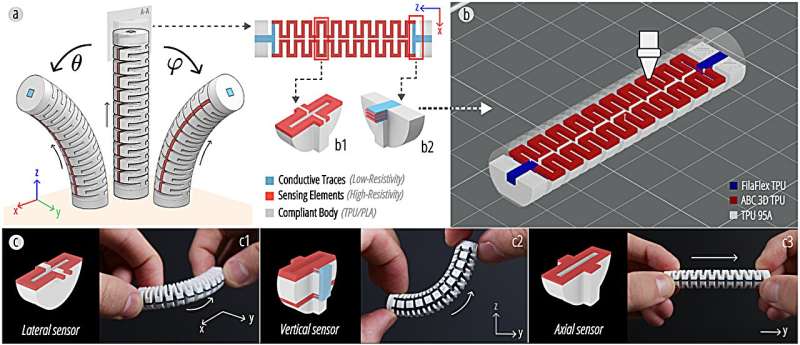
Embedding sensors into 3D-printed objects is not new, but previous methods often used similar conductive materials for both sensors and electrical traces. Their signals could interfere with each other, making it difficult to accurately interpret movement. X-Hinges addresses this problem by using separate materials optimized for sensing and conductive traces.
The software allows designers to assemble objects from customizable shapes and define movement along as many as three axes: vertical, lateral, and axial compression. X-Hinges then automatically positions sensors around flexible joints to measure deformation. The complete device can be fabricated through a single multimaterial fused deposition modeling process.
Researchers demonstrated the approach with several prototypes. A sensing glove captures finger movements and transfers the information to a humanoid robotic hand, potentially helping robots learn manipulation tasks. An origami-inspired lamp detects when it is pinched and changes brightness. Another device identifies objects placed on its surface using tactile information. The team also created an interactive shark-shaped game controller.
A remaining challenge is calibration. Small variations in printed electrical components can cause otherwise identical devices to generate different sensor readings. The researchers developed a computer vision-based calibration method to align their outputs but ultimately want recalibration built directly into the system.
The longer-term goal is to integrate sensing and actuation within the same fabrication process. Such objects could both perceive and physically respond to their surroundings, providing new hardware platforms for robotics, embodied AI, interactive products, and physically intelligent devices.
