

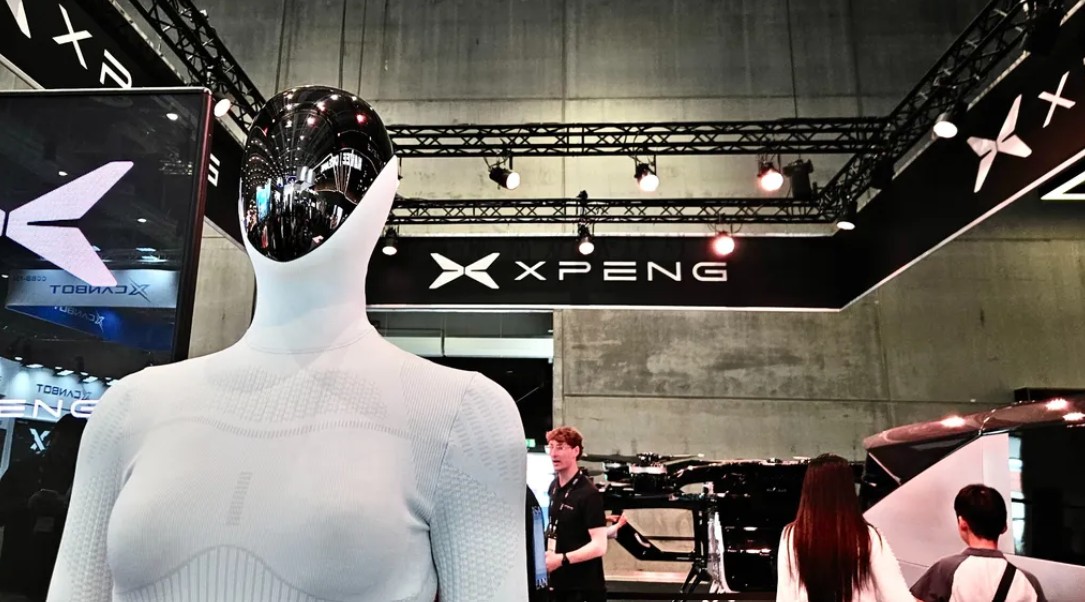
Chinese technology company Xpeng has begun mass production of IRON, an AI-powered humanoid robot designed to eventually handle tasks ranging from commercial services to household chores. The robot attracted attention in 2025 for its unusually humanlike appearance and movement. Xpeng representatives discussed the production model at IFA 2026 in Berlin, tells Live Science.
IRON stands about 5 feet 7 inches tall and weighs 143 pounds. Its fabric-covered body is available in different forms, while the production version provides 76 degrees of freedom, including 21 in each hand. It can move at roughly 6.5 feet per second, comparable to a fast walking pace. Xpeng says the robot can understand instructions, plan actions, navigate environments, avoid obstacles, and automatically find a charging station when its battery runs low.
Much of IRON’s intelligence draws on AI technology Xpeng already uses for electric vehicles and flying-car prototypes. The robot combines vision-language-action, vision-language, and vision-language-task or thought models. Together, these systems are intended to connect visual perception and language understanding with reasoning and physical movement.
Three Turing AI chips provide a combined 2,250 trillion operations per second of processing performance. According to Xpeng, this computing capacity allows IRON to run advanced AI models locally rather than relying entirely on internet connectivity.
Humanoid robotics, however, remains technically difficult. Real-world environments are unpredictable, making reliable navigation and object manipulation challenging. Xpeng is addressing this problem through its world model and AI frameworks designed to help robots anticipate actions rather than depend on repeated trial and error.
Initially, IRON will work in Xpeng showrooms and technology campuses. External commercial shipments are planned for 2027, beginning primarily in China for applications such as customer service and guided tours before potentially expanding internationally. Xpeng ultimately envisions humanoid robots becoming common in homes, where they could perform everyday tasks including cleaning and folding laundry.
