

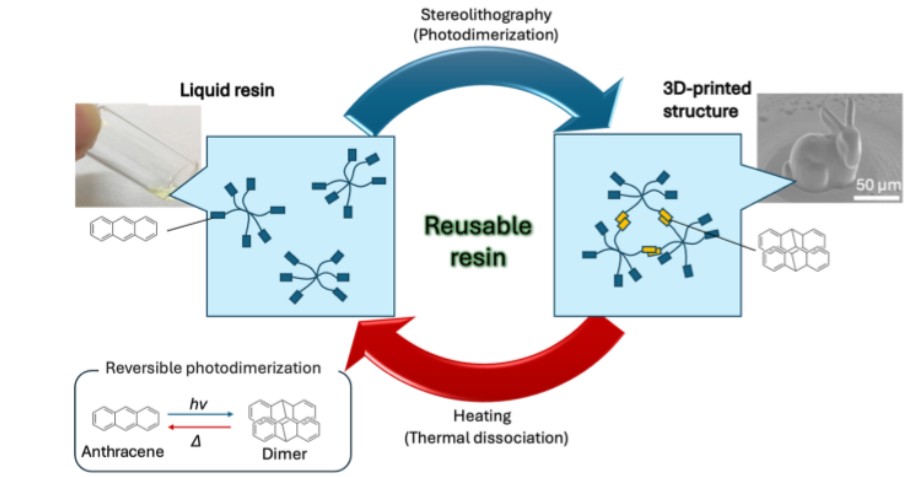
Researchers from Yokohama National University have developed a recyclable material for 3D printing that could help address one of additive manufacturing’s most persistent environmental problems: the difficulty of reusing cured printing resins. Reported by 3D Printing Industry, the research focuses on creating a material system capable of repeated recycling without severe degradation in mechanical performance.
Many existing 3D-printing materials, especially photopolymer resins used in high-precision additive manufacturing, are difficult to recycle once cured. Unlike thermoplastics that can often be remelted and reshaped, cured resin systems typically form permanent cross-linked structures that become challenging to recover or reuse effectively. As additive manufacturing expands into larger-scale production, this limitation has become a growing environmental and industrial concern.
The Yokohama National University team addressed this issue by engineering a resin material with reversible chemical characteristics that allow printed components to be broken down and reprocessed more efficiently. According to the article, the researchers demonstrated that the material could retain important structural and mechanical properties even after multiple recycling cycles, an essential requirement for practical manufacturing applications.
The work is significant because it targets one of the core contradictions within additive manufacturing. Although 3D printing is frequently promoted as a low-waste production method due to its layer-by-layer fabrication process, failed prints, support structures, discarded prototypes, and obsolete parts still generate substantial material waste. Resin-based systems are particularly problematic because their chemical structure often prevents straightforward recycling.
The researchers believe the recyclable material could support more sustainable workflows in industries that rely heavily on rapid prototyping and iterative design, including healthcare, engineering, electronics, and consumer manufacturing. Closed-loop printing systems, where materials are continuously recovered and reused locally, may eventually become more feasible through advances like this.
The article positions the research within a broader movement toward circular manufacturing, where materials are designed not only for performance but also for long-term recoverability and reuse. Rather than treating recyclability as an afterthought, the Yokohama team’s work suggests that future additive manufacturing systems may increasingly integrate sustainability directly into material chemistry itself.
