

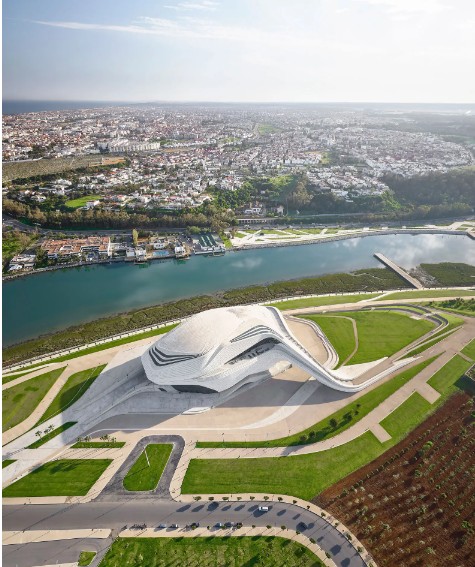
Zaha Hadid’s Royal Theater of Rabat transforms a performing arts venue into an architectural spectacle. Built beside Morocco’s Bou Regreg River, the theater appears as a series of waves rising and falling across the landscape. Inside, ribbonlike stairways, canyonlike lobbies, and a geode-inspired auditorium extend the sense of movement beyond the stage. The project reflects Hadid’s late-career pursuit of ultimate movement and fluidity, enabled by increasingly sophisticated digital design technology, tells The New York Times (full article available to subscribers).
King Mohammed VI invited Hadid to design the theater in 2010 after her earlier proposal for a Casablanca theater lost a competition. Hadid chose instead to create a new design specifically for the river valley between Rabat and Salé. The commission also carried personal significance after her painful loss of the Cardiff Opera House project decades earlier.
Advanced three-dimensional design and construction software made the building’s difficult curves feasible. Glass fiber-reinforced concrete panels could be molded into complex forms, allowing the exterior to follow the fluid geometry Hadid envisioned. The main wave rises over a 1,800-seat auditorium before descending toward the entrance. A promenade continues through the interior to a 7,000-seat outdoor auditorium beside the river.
The main hall combines technical performance with intimacy. Its horseshoe-shaped seating brings audiences closer to performers, while visitors at the opening praised its acoustics, backstage space, and functionality. Construction began in 2014 and finished in 2021, but the pandemic, supply chain problems, and Morocco’s 2023 earthquake delayed its public opening.
The $170 million theater also supports Morocco’s ambition to strengthen its cultural influence across Africa and internationally. For Hadid, who had Iraqi roots and longstanding connections to the region, the project represented a cultural homecoming. Her final vision makes architecture itself part of the performance, carrying wonder beyond the curtain and throughout the building.
