

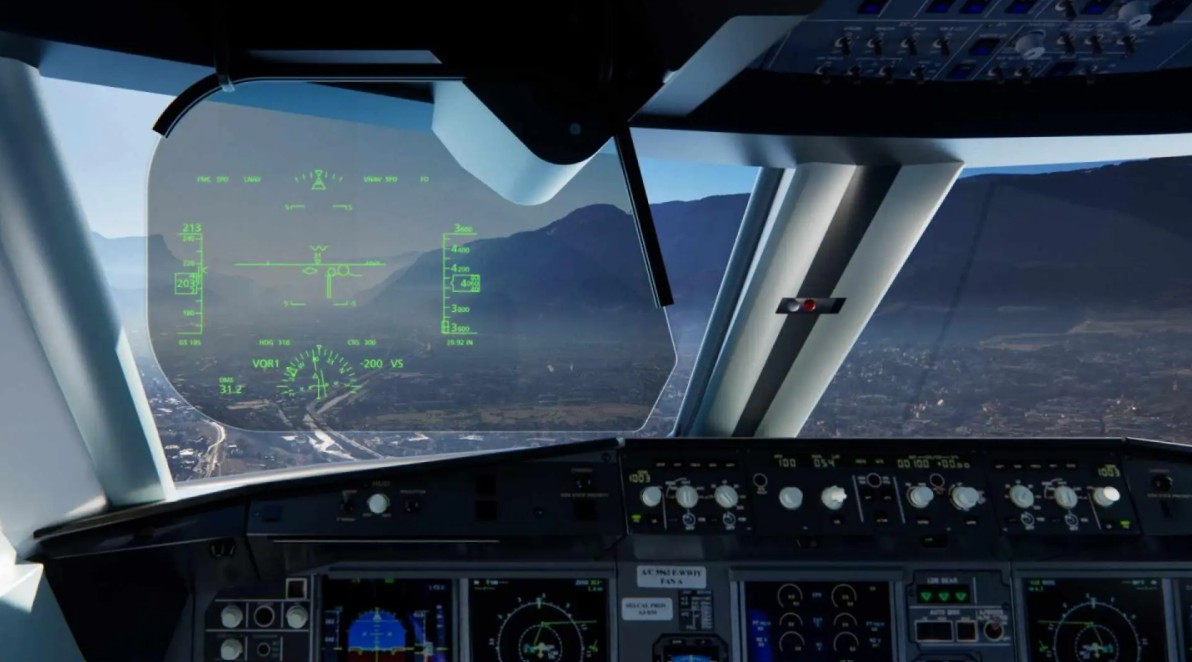
Zeiss is bringing decades of research in holographic optical elements into aviation with display technology designed to reduce the size and weight of conventional projection systems. Demonstrated at the Farnborough International Airshow, the technology could support cockpit head-up displays, interactive cabin controls, passenger information systems, and security applications, tells New Atlas.
The system uses microscopic optical structures applied to transparent foil or flat glass. Instead of conventional mirrors and lenses, these elements use laser light and diffraction to redirect images. They respond to specific laser wavelengths and angles while allowing ambient light to pass through, helping projected information remain visible without blocking the view through the glass. The compact optical architecture also gives aircraft designers more flexibility in positioning projectors.
Zeiss demonstrated a virtual 3D button combined with motion sensing, allowing users to operate a control without touching a physical surface. In another demonstration, a business-jet cabin divider became a transparent display capable of showing a virtual flight attendant and passenger information. Such displays could provide greetings, announcements, or emergency instructions without conventional screens.
The more significant aviation application is Zeiss’s next-generation head-up display. Conventional HUD projection equipment can be too bulky for smaller aircraft. Zeiss has reduced the optical system while retaining a wide field of view. A simulated helicopter demonstration showed flight information and an Enhanced Flight Vision System that helped the pilot navigate through fog and whiteout conditions.
Zeiss also demonstrated holographic facial scanning for potential security applications. The company says its current system can be five to six times lighter than conventional alternatives, potentially reducing aircraft weight, fuel consumption, and operating costs. Business and commercial aviation remain the primary markets, although Zeiss is also evaluating lower-cost versions for general aviation.
