

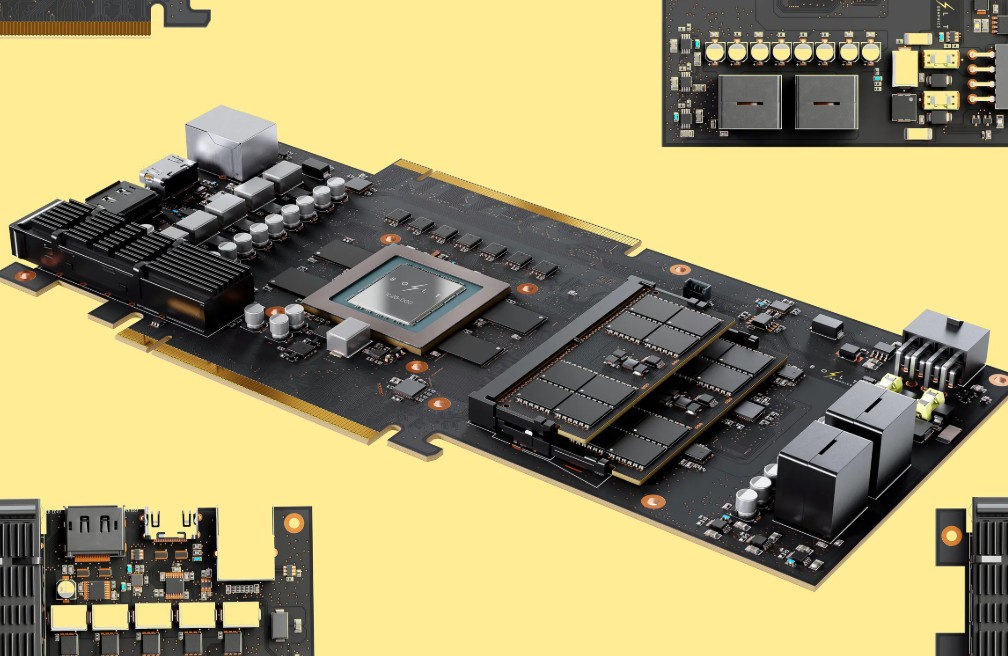
Startup Bolt Graphics is entering the increasingly competitive GPU market with a processor architecture designed to rethink the balance between graphics rendering, simulation, and artificial intelligence workloads. In an article published by IEEE Spectrum, the company’s upcoming Zeus GPU is presented as an attempt to address limitations in current GPU designs that were originally optimized primarily for graphics processing.
Unlike traditional GPUs built mainly around rasterized graphics and parallel shading tasks, Zeus is designed with a stronger focus on physics simulation, scientific computing, and complex real-time modeling. Bolt Graphics argues that emerging AI systems, robotics, digital twins, and engineering simulations increasingly require hardware capable of handling physical interactions and dynamic environments alongside standard AI inference tasks.
The article explains that the Zeus architecture combines ray tracing, rendering, physics computation, and AI acceleration within a unified framework. Rather than separating these functions into distinct processing pipelines, the company aims to integrate them more closely to reduce data-transfer bottlenecks and improve efficiency in simulation-heavy applications.
A major emphasis is placed on digital physics. According to Bolt Graphics, future AI systems will need a deeper understanding of real-world physical behavior in order to interact reliably with environments, machines, and humans. The company believes existing GPU architectures are not fully optimized for this transition because they evolved primarily from gaming and graphics markets.
The article also notes the immense challenge of competing in the GPU industry, where dominant firms such as NVIDIA control large portions of the AI and accelerated-computing ecosystem. Hardware success depends not only on chip performance but also on software support, developer adoption, manufacturing scale, and compatibility with existing workflows.
Even so, Bolt Graphics reflects a growing movement toward specialized computing architectures tailored for simulation-driven AI and industrial applications. As robotics, engineering, autonomous systems, and scientific modeling continue expanding, demand may increase for processors capable of handling both visual computation and physically accurate simulation simultaneously.
The Zeus project ultimately represents a broader shift occurring across high-performance computing, where future processors are increasingly being designed not only to process data faster but also to model reality more intelligently.
