

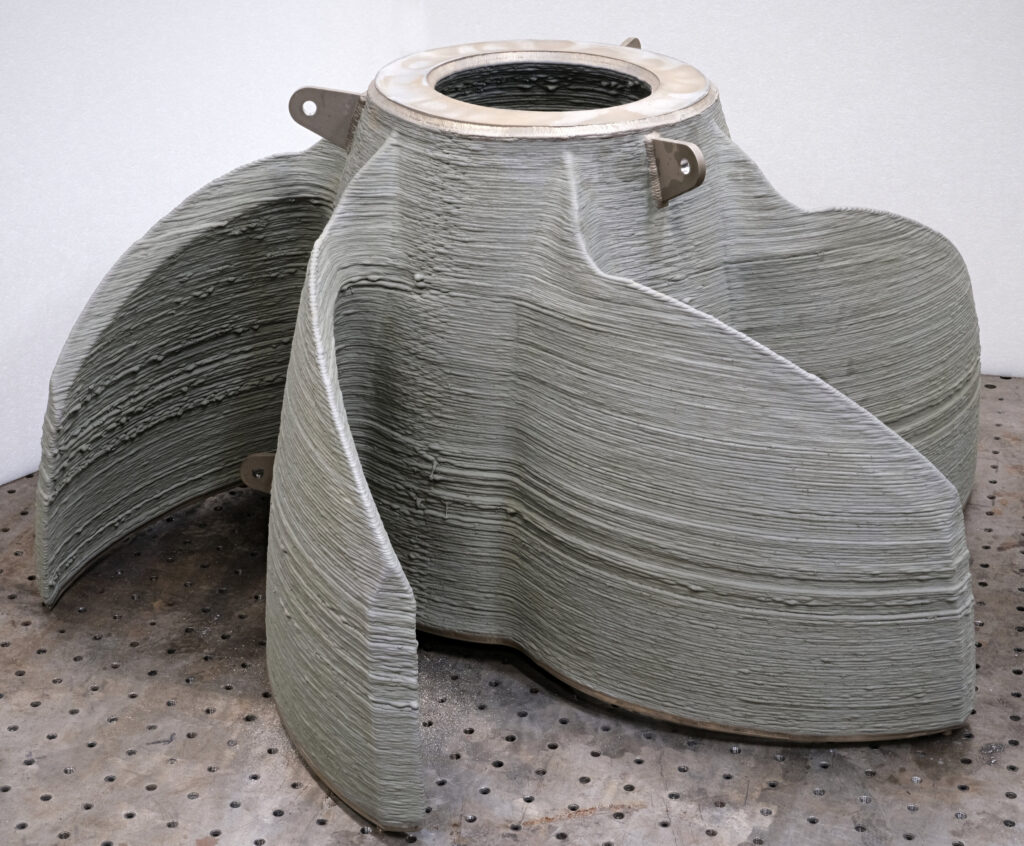
Researchers at the U.S. Department of Energy’s Oak Ridge National Laboratory (ORNL) have developed a manufacturing approach that combines additive manufacturing with powder metallurgical hot isostatic pressing (PM-HIP), opening a new path for producing large and highly durable metal components. The method focuses on 3D printing custom canisters used during PM-HIP processing, reducing production complexity while improving design flexibility for industries such as aerospace, energy, hydropower, and nuclear engineering, tells Tech Xplore.
PM-HIP is already used to create dense metal parts by filling sealed containers with metal powder and subjecting them to extreme heat and pressure. Traditionally, however, manufacturing the canisters themselves involves multiple labor-intensive stages, including forming, machining, and welding. These processes increase production costs and can introduce structural defects or geometric limitations. ORNL’s researchers replaced those conventional fabrication steps with additive manufacturing, allowing canisters to be printed directly in highly customized shapes.
Once printed, the canisters are filled with metal powder, vacuum-sealed, and processed in a hot isostatic press. The pressure and temperature compress the powder into fully dense metal parts with minimal internal flaws. According to the researchers, this approach enables components to be manufactured much closer to their final geometry, reducing waste material and shortening development timelines.
The project also explored multiple additive manufacturing techniques, including laser-based and wire-based printing systems. Researchers noted that the process supports advanced alloys engineered for corrosion resistance, radiation tolerance, and stability under extreme temperatures, qualities that are especially valuable in next-generation nuclear reactors and demanding aerospace applications.
Another important aspect of the work involves predictive modeling. ORNL researchers developed computational tools capable of forecasting shrinkage, distortion, and material behavior during the PM-HIP process. These simulations reduce the need for trial-and-error manufacturing and improve consistency when producing large structural parts.
The study presents additive manufacturing not simply as a prototyping tool but as an enabling technology for industrial-scale metallurgy. By merging 3D printing with PM-HIP, the researchers believe manufacturers could gain greater control over complex metal production while strengthening supply-chain resilience for critical infrastructure and national security applications.
