

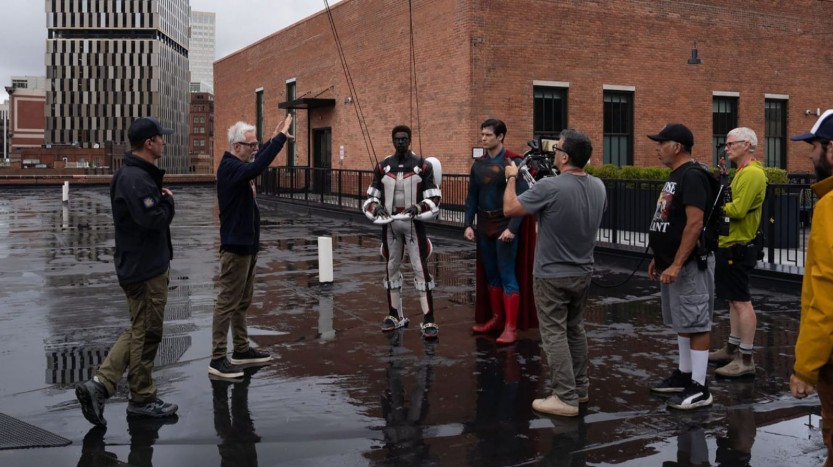
Modern blockbuster filmmaking increasingly depends on speed without sacrificing realism, and Superman (2025) offers a clear example of that shift. The article from the 3D Printing Industry blog details how Legacy Effects transformed its production workflow by deeply integrating 3D printing into the creation of physical props, costumes, and animatronics.
Facing tight production schedules and growing complexity, the studio needed a way to bridge the gap between rapid prototyping and high-quality, camera-ready parts. Traditional methods forced a trade-off: fast prints lacked surface finish, while polished components required slower, more expensive processes. Introducing Bambu Lab’s X1C 3D printers mid-production changed that balance, enabling parts to be produced quickly while maintaining sufficient quality for on-set use.
What began as a small test, notably on the Hammer of Boravia armor, quickly expanded across the entire fabrication pipeline. The printers became central to producing a wide range of assets, from full costume assemblies to mechanical components. In some cases, parts could move directly from the printer to the set without requiring rework, significantly reducing turnaround time and cost.
The technology also enabled rapid iteration. Teams could design, print, test, and refine multiple versions of a component within a single day, allowing creative and engineering teams to collaborate more fluidly. This iterative speed proved especially valuable for complex builds such as animatronic robots and articulated props, where fit, motion, and durability had to be validated quickly.
Beyond speed, 3D printing contributed to performance and usability. Lightweight printed components replaced heavier materials, improving comfort for stunt performers and reducing physical strain during action sequences. At the same time, the ability to produce precise, custom-fit parts enhanced realism on screen.
The broader implication is a shift in the role of additive manufacturing within film production. No longer limited to prototyping, 3D printing is becoming a primary fabrication method, connecting digital design directly to finished physical assets. In Superman (2025), this approach reshaped both workflow and outcome, demonstrating how emerging manufacturing technologies are redefining practical effects in modern cinema.
