
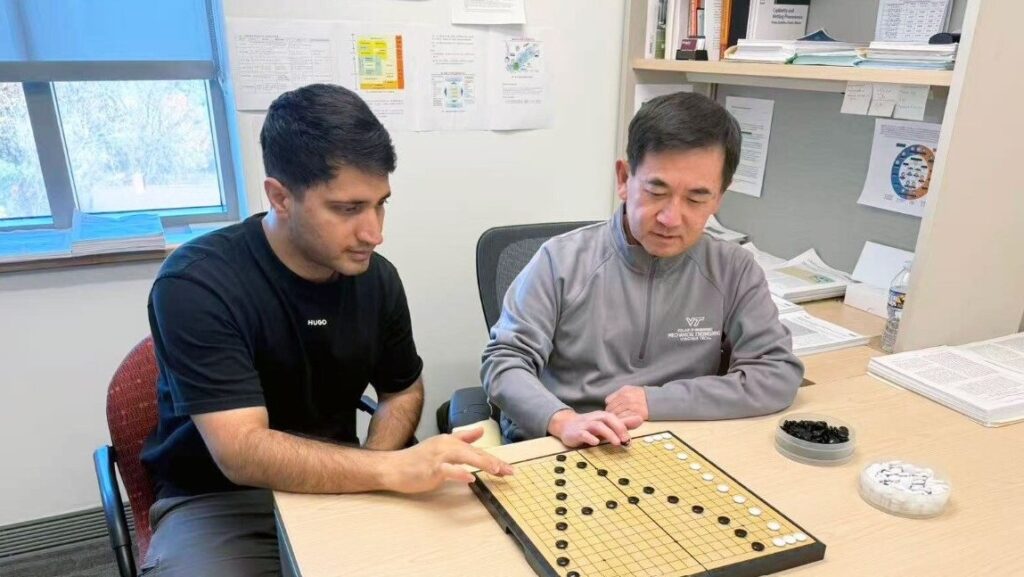
Researchers have developed a novel way to analyze cooling strategies for high-power machines by combining artificial intelligence with tactics inspired by an ancient board game, Go, tells Tech Xplore. Cooling electronics and power systems efficiently is critical because heat buildup can disrupt operations, trigger failures, or even cause blackouts in power grids and data centers. Traditional methods of modeling cooling, especially spray cooling, where a liquid is sprayed onto a surface to rapidly remove heat, are computationally intensive and slow. To improve this, a mechanical engineering team used AI algorithms patterned on strategic decision-making from the millennia-old game Go to search for optimal cooling approaches.
Go, a Chinese strategy game known for its extraordinarily large space of possible moves and deep tactical considerations, has long attracted AI research. Its emphasis on spatial strategy and long-term planning makes it a fitting metaphor for difficult optimization problems. In this case, researchers from the University of Texas at Austin and their collaborators devised AI systems that explore combinations of spray-cooling parameters, such as droplet size, placement, and flow patterns, in a search space much like Go’s board positions. The system identifies strategies that reduce heat more effectively than traditional heuristics or brute-force search.
The resulting model provides a data-informed way to predict which cooling setups will perform best, potentially lowering simulation costs and speeding engineering design cycles. The team published their findings in the journal Artificial Intelligence Review, showing that AI can uncover efficient cooling tactics by drawing on abstract strategy patterns rather than explicit physical rules.
This work points to a broader trend in engineering: using insights from diverse disciplines, even ancient games, to guide AI toward smarter solutions in complex domains such as thermal management. The approach could eventually help optimize cooling in electronics, energy infrastructure, and high-performance computing, where effective heat removal remains a persistent engineering challenge.
