

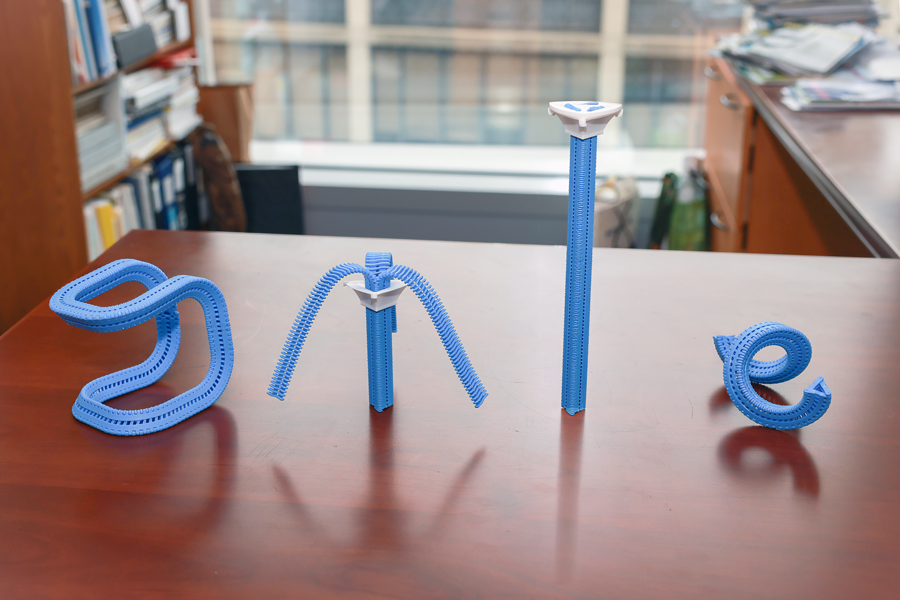
A decades-old concept for a three-sided zipper has been revived by engineers at MIT, resulting in a new class of fasteners capable of transforming objects between flexible and rigid states. The work, featured in MIT Computer Science and Artificial Intelligence Laboratory coverage, builds on a 1985 idea by Professor William Freeman, who envisioned a triangular zipper that could reshape structures rather than simply close fabric, tells MIT News.
At the time, the idea was impractical due to manufacturing limitations. Today, advances in digital design and 3D printing have made it feasible. Researchers developed a software system that allows users to design customized three-sided “Y-zippers,” which can then be fabricated automatically using common printing materials like plastics.
Unlike conventional zippers, which operate on flat surfaces, the Y-zipper enables three-dimensional transformations. When unzipped, it expands into flexible, tentacle-like forms; when closed, it becomes a rigid structure such as a rod or frame. This ability to “tune” stiffness gives designers a new way to create objects that can change shape on demand.
The applications are broad. In practical demonstrations, the system simplified tasks such as assembling a tent, reducing setup time significantly. In healthcare, the researchers wrapped the zipper around a wrist cast, allowing it to loosen for comfort and tighten for support. The mechanism also shows promise in robotics, where attaching motors enables adaptive movement, such as changing limb length to navigate uneven terrain.
Durability tests further validated the design. The fasteners withstood thousands of open-and-close cycles, with their elastic structure distributing stress effectively. Researchers note that future versions could use stronger materials such as metal to support larger-scale applications.
The project demonstrates how revisiting overlooked ideas can yield powerful innovations when paired with modern tools. By turning a simple fastening mechanism into a programmable structural element, the Y-zipper opens new possibilities in engineering design, bridging the gap between soft flexibility and rigid stability.
