

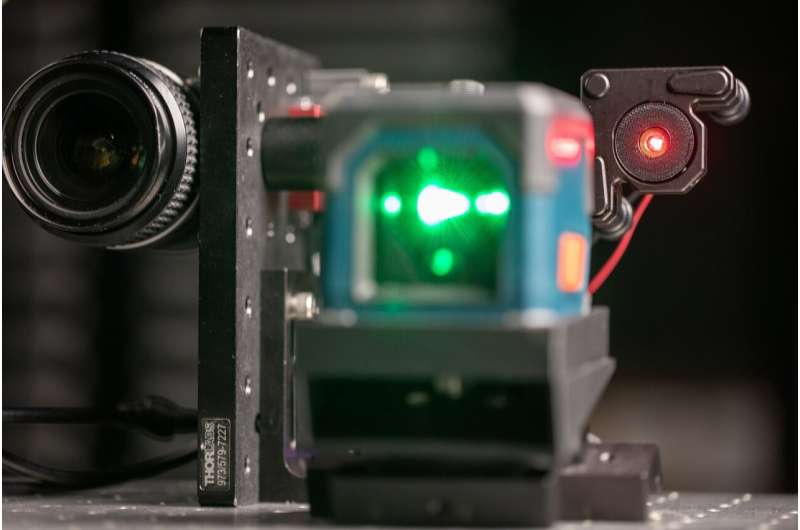
A lesser-known optical principle from early photography is finding new relevance in modern sensing systems. The article from Tech Xplore report describes how Scheimpflug cameras are being adapted to deliver LiDAR-like capabilities across dramatically extended distances, from just a few meters up to several kilometers.
Traditional LiDAR systems rely on time-of-flight measurements using laser pulses to determine distance, which often requires complex electronics and high power. In contrast, Scheimpflug-based systems use a geometric optical arrangement in which the camera sensor is tilted relative to the lens. This configuration allows depth information to be encoded directly into the image, eliminating the need for precise timing electronics.
The result is a sensing approach that is significantly simpler, lighter, and potentially more cost-effective. Researchers at the Georgia Tech Research Institute are exploring this technique for applications that demand both short- and long-range detection. Early demonstrations show that these cameras can capture range-resolved data from as close as 6 meters to as far as 4 kilometers, a span that rivals or exceeds many conventional LiDAR systems.
One of the most promising use cases lies in atmospheric monitoring. The system can observe how laser light propagates through air, providing insights into turbulence, aerosols, and other environmental factors. This capability is valuable for both scientific research and practical applications such as aviation safety and environmental sensing.
Beyond atmospheric studies, the technology is being evaluated for dynamic object tracking, including airborne targets. Its ability to operate at close range as well as over long distances makes it versatile for robotics, mapping, and surveillance tasks.
While still under development, Scheimpflug-based sensing suggests a complementary path to LiDAR rather than a direct replacement. By reducing system complexity while maintaining strong performance across a wide range of distances, it opens the door to more accessible and adaptable 3D sensing systems across multiple industries.
