

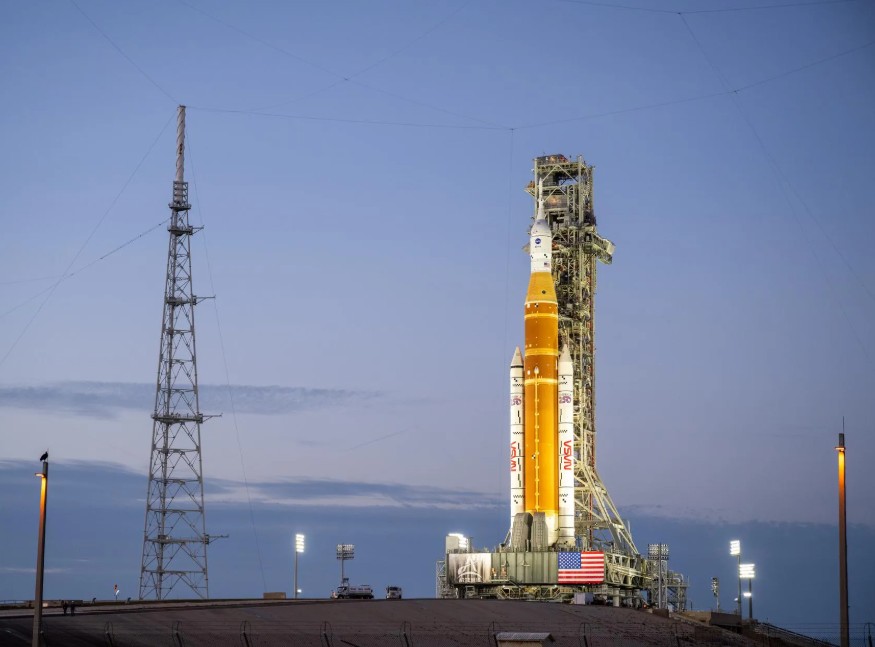
NASA’s Artemis II mission marks a decisive step back into deep-space human exploration, sending astronauts beyond low Earth orbit for the first time in over five decades. The mission will carry a crew of four aboard the Orion spacecraft, launched by the Space Launch System rocket, on a journey that extends far beyond previous human missions since the Apollo era, tells Wired.com.
The flight follows a free-return trajectory, a carefully calculated path that uses the Moon’s gravity to swing the spacecraft around its far side and guide it safely back to Earth. This route allows astronauts to travel hundreds of thousands of miles from Earth while maintaining a built-in safety margin. As the spacecraft passes behind the Moon, communication with Earth will temporarily drop, recreating a moment of isolation experienced only by Apollo astronauts.
The mission is designed as a full systems test under real conditions. Engineers and astronauts will evaluate Orion’s life-support systems, propulsion, navigation, and thermal protection while exposed to deep-space radiation and extended flight durations. These tests are essential before committing to future missions that will land humans on the lunar surface and eventually aim for Mars.
Beyond its technical goals, the journey offers a rare human perspective of the Moon’s far side, a rugged and heavily cratered landscape that remains hidden from Earth due to tidal locking. The experience underscores both the scientific and symbolic importance of returning humans to lunar orbit.
Artemis II also reflects a broader shift in space exploration. Unlike the short, race-driven missions of the Apollo program, Artemis is structured for long-term presence, with plans to establish sustained lunar operations and develop infrastructure for deeper space missions.
This mission bridges the past and future, combining proven trajectory strategies with modern spacecraft systems. It signals a renewed commitment to human exploration, not as a one-time achievement, but as a continuous effort to expand humanity’s reach beyond Earth.
