
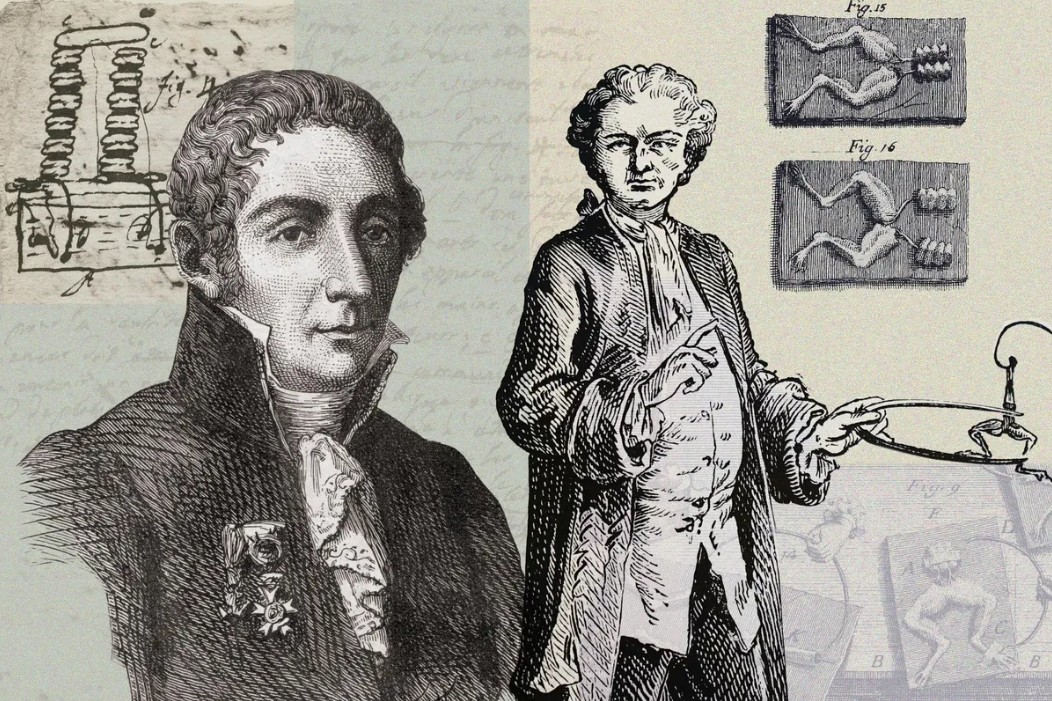
The first battery emerged from an 18th-century scientific disagreement over twitching frog legs. Italian physician Luigi Galvani spent decades investigating why the muscles of dissected frogs contracted when exposed to electricity. He concluded that animals contained an innate electrical force, which he called animal electricity, tells IEEE Spectrum.
Physicist Alessandro Volta initially agreed but changed his mind after conducting his own experiments. He argued that the frog did not generate electricity. Instead, he believed the electrical charge came from contact between two different metals, while the frog simply revealed its presence.
To test his theory, Volta created an artificial electric organ in 1799. The device consisted of alternating copper and zinc discs separated by cardboard, cloth, or blotting paper soaked in brine or acid. Connecting the top and bottom produced a continuous electrical current. Unlike Leyden jars, which stored charge and released it quickly, Volta’s device generated sustained electricity through chemical reactions. It became known as the voltaic pile and is recognized as the first battery.
The invention quickly transformed scientific research. Within weeks of Volta describing it to the Royal Society, William Nicholson and Anthony Carlisle used a voltaic pile to split water into hydrogen and oxygen, demonstrating electrolysis. Humphry Davy later used larger piles to isolate elements including potassium, sodium, calcium, strontium, and barium.
The disagreement also influenced popular culture. Galvani’s nephew Giovanni Aldini publicly used electricity to stimulate animal carcasses and bodies of executed criminals. Such demonstrations contributed to speculation about electrically restoring life and helped inspire Mary Shelley’s Frankenstein.
The article argues that neither Galvani nor Volta should be viewed simply as the winner. Galvani correctly connected electricity with muscle contraction, while Volta established principles that led to electrochemistry and battery science. Their competing explanations ultimately helped create two important scientific fields.
