

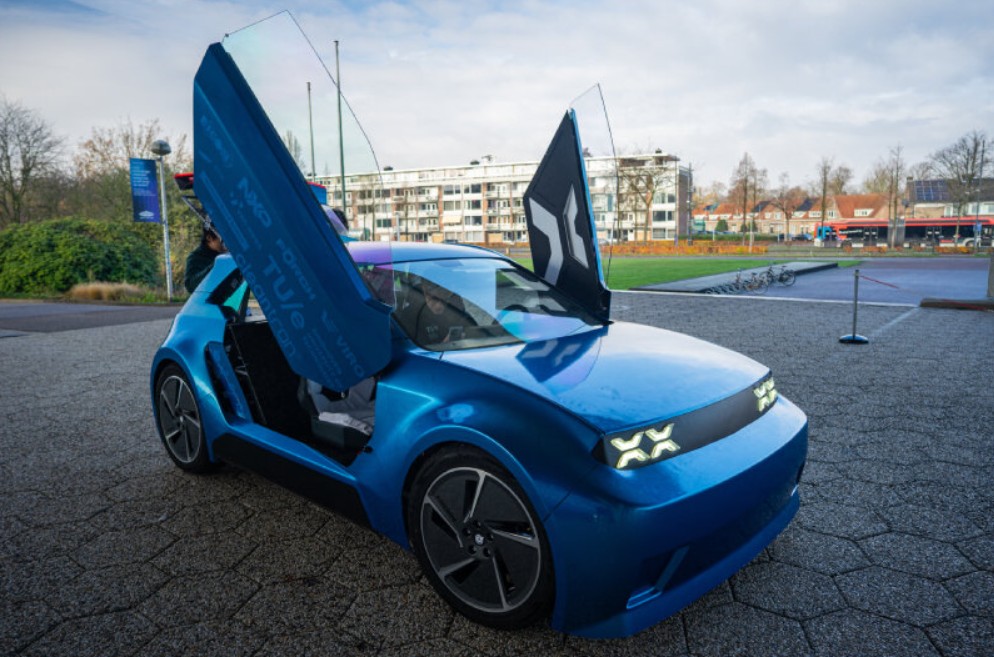
A team of students from Eindhoven University of Technology’s TU/ecomotive group has revealed ARIA, a modular electric city car designed so owners can repair and maintain it themselves with simple tools and clear guidance. ARIA stands for “Anyone Repairs It Anywhere,” and the project aims to push the auto industry and policymakers to rethink the way electric vehicles are built, maintained, and regulated, tells this article from designboom.
Unlike traditional EVs with sealed battery packs and proprietary systems that require dealer service, ARIA’s architecture breaks the vehicle into distinct, replaceable components. The battery consists of six modules, each weighing about 12 kg, that the owner can remove and swap individually without specialized equipment. That design dramatically lowers repair barriers and costs, extending the car’s useful life and reducing waste, a key sustainability objective.
Body panels and interior electronics follow the same modular philosophy. Panels attach with standardized fasteners and can be popped off and replaced quickly. An included diagnostic app reads the car’s status and walks users through repair steps, while a built-in toolbox gives owners what they need to work on their vehicle at home rather than at a service center.
ARIA’s performance suits its role as an urban commuter: it offers about 137 miles of range and a top speed of around 56 mph. Its simplicity isn’t about power or luxury but about practical, accessible mobility.
The TU/ecomotive team sees ARIA as both a technical proof of concept and a policy statement. They want European regulators to extend “right to repair” laws, currently aimed at appliances and electronics, to electric cars so that owners and independent shops can access parts, manuals, and diagnostics without manufacturer gatekeeping.
ARIA remains a prototype with no plans for commercial production, but it demonstrates that EVs can be designed for repairability, sustainability, and user empowerment, not just sealed complexity and expensive service dependencies.
