

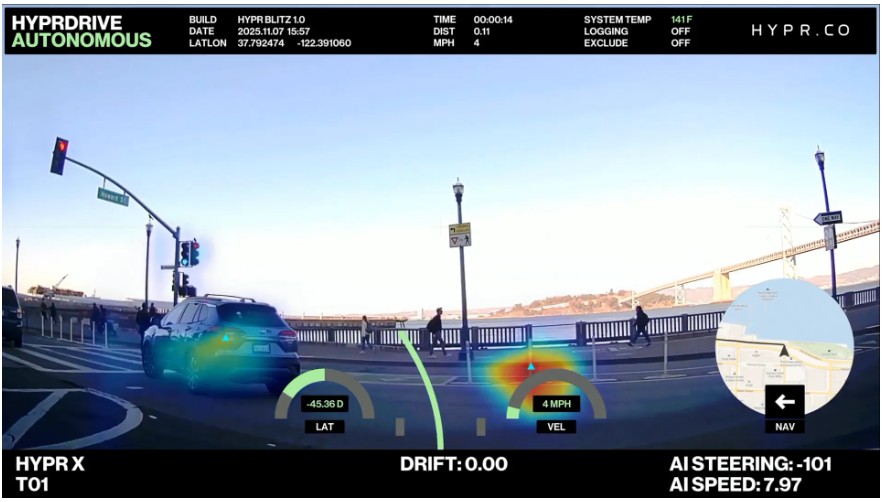
HyprLabs, a small startup split between Paris and San Francisco, is taking an unconventional path toward autonomous vehicles and future robots by building self-driving software with far less data and computing power than rivals traditionally require, tells Wired.com. Led by Zoox cofounder Tim Kentley-Klay, the team has been developing and testing its platform, called Hyprdrive, by modifying two Tesla Model 3s with extra cameras and a compact on-board computer to gather real-world driving experience.
Despite having only about $5.5 million in funding and 17 team members, the company aims to prove that autonomy can be achieved faster and more efficiently than with the massive datasets and costly infrastructure typically used in self-driving AI development.
Unlike established approaches that rely either on enormous fleets and camera-only data (as Tesla does) or on expensive multi-sensor setups with extensive human annotations (as Waymo and Cruise employ), HyprLabs blends the two. Its “run-time learning” technique uses a transformer-based neural model that continues to learn in real time under human supervision. Only novel data gets sent back to the company’s servers for fine-tuning, dramatically reducing the amount of computing and labeling work needed to train the system. So far, the team has used roughly 1,600 hours of driving data for training, a tiny fraction compared with competitors’ tens of millions of collected miles.
While the software isn’t ready for unsupervised public deployment, the early results show promise. The company claims its architecture could accelerate development and make autonomous systems more scalable and resource-efficient. Beyond cars, HyprLabs also envisions building its own class of robots, described humorously by Kentley-Klay as a cross between R2-D2 and a speedy character, that will learn and adapt quickly in diverse environments.
HyprLabs is in talks to license its platform to other robotics developers and sees run-time learning as a competitive advantage in a field that has struggled with lengthy timelines, high costs, and safety hurdles. The coming year will test whether this lean, data-efficient approach can truly rival the heavily funded giants of autonomous technology.
