

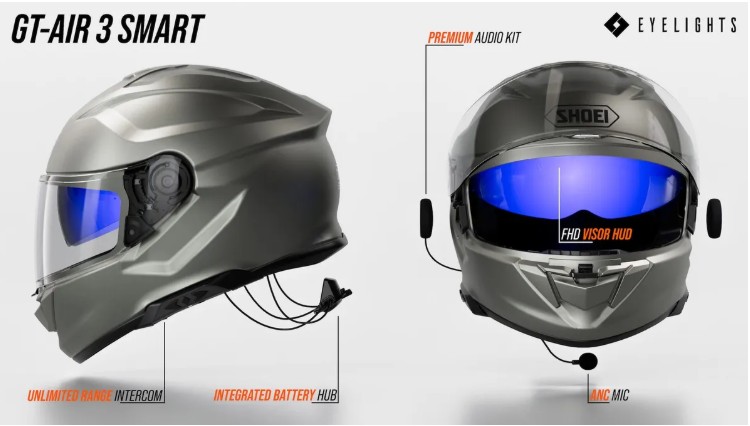
Shoei has unveiled what it calls the world’s first motorcycle helmet with a fully integrated visor-mounted head-up display, a move that could change how riders access information on the road. Reported by TechRadar, the new helmet builds on Shoei’s GT-Air platform and integrates augmented reality technology developed with French startup EyeLights, embedding digital information directly into the rider’s field of view rather than adding a bulky external module.
The HUD projects key riding data onto a small area of the visor, allowing riders to see speed, navigation prompts, alerts, and system notifications without looking down at a dashboard or smartphone. The idea is simple but powerful: reduce distraction by keeping the rider’s eyes forward and attention on traffic. Unlike clip-on displays or aftermarket add-ons, Shoei’s system is designed from the ground up to be part of the helmet, preserving balance, aerodynamics, and safety certification.
The display uses a compact optical module and a nano-OLED screen, positioned so information appears to float at a comfortable viewing distance. Controls are handled through a handlebar-mounted controller, voice commands, or connected devices, minimizing the need for physical interaction while riding. The helmet also integrates Bluetooth audio, intercom functionality, and smartphone connectivity, consolidating features that many riders currently piece together from multiple accessories.
Power comes from an internal battery rated for several hours of active use, enough for daily commuting or long rides, with charging handled off the bike. Shoei emphasizes that the helmet still meets its core priorities: protection, comfort, noise control, and ventilation, areas where the brand has built a strong reputation over decades.
While pricing and availability place the helmet firmly in the premium category, TechRadar notes that the concept makes practical sense. Riders already rely heavily on navigation apps and digital data; integrating that information cleanly and safely into a helmet could be more effective than mounting screens on handlebars or glancing at phones.
Shoei’s visor-mounted HUD signals a broader shift toward built-in rider technology, where safety gear becomes an intelligent interface rather than a passive shell.
