

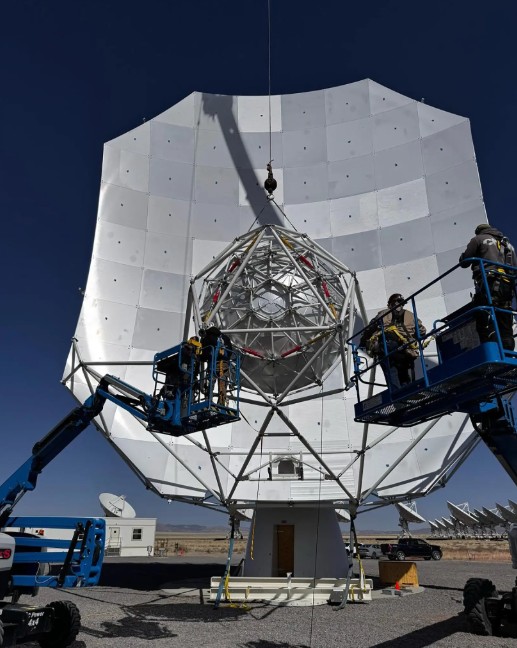
Astronomers are preparing for a major leap in radio astronomy with the development of the Next Generation Very Large Array, or ngVLA, a vast telescope system planned across the southwestern United States and northern Mexico, tells The New York Times (full article available to subscribers). The project will consist of 263 radio antennas spread across New Mexico, Texas, Arizona, and additional locations throughout the country. Scientists hope the ngVLA will unlock new views into the processes that shape stars, planets, galaxies, and black holes.
The observatory recently reached an important milestone when a prototype antenna captured its first cosmic radio signals. These included observations of the sun, the remnants of a supernova, and emissions from a distant supermassive black hole. Researchers see the achievement as part of a broader global movement toward more powerful radio-array telescopes capable of examining regions of the universe invisible to optical instruments.
Radio telescopes detect long wavelengths of light emitted by gas, dust, and energetic cosmic phenomena. Because these wavelengths are far larger than visible light, astronomers must rely on enormous instruments to achieve detailed resolution. Rather than building a single gigantic dish, modern observatories combine signals from many smaller antennas distributed across large distances, effectively creating one massive virtual telescope.
The ngVLA is designed to replace both the existing Very Large Array and the Very Long Baseline Array with smaller but more precise antennas. According to project scientists, the design strikes a balance between dish size and surface precision, enabling observations across a wider range of radio frequencies.
The article also highlights other major international projects, including the Square Kilometer Array in South Africa and Australia and the planned Next Generation Event Horizon Telescope. Together, these next-generation observatories are expected to provide complementary perspectives on the universe. By combining radio observations with optical and infrared astronomy, researchers hope to assemble a richer and more complete picture of cosmic evolution.
