

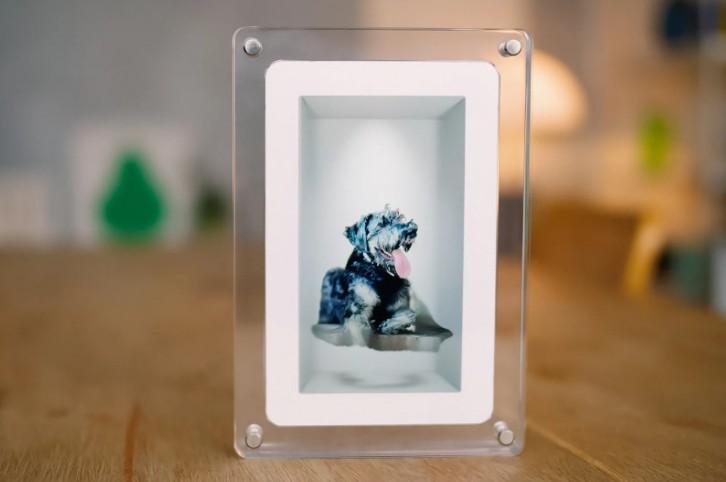
Holograms have long been a staple of science fiction, appearing in films and television series that depict futuristic communication and computing. In reality, however, holographic technology has remained largely confined to research labs and specialized industrial displays. The company Looking Glass is attempting to bring that vision closer to everyday life with Musubi, a consumer-focused holographic picture frame that transforms ordinary photos and videos into three-dimensional images, tells Wired.com.
Musubi is a compact 7-inch digital frame designed to display images with depth, giving the illusion that objects hover inside the frame rather than appearing on a flat screen. Users can upload photos or short videos, and built-in software uses artificial intelligence to analyze the image, identify the main subject, and convert it into a 3D visual scene. The resulting holographic effect can be viewed from a wide 170-degree viewing angle, allowing multiple people to see the image from different perspectives without wearing special glasses.
The system relies on Looking Glass’s display approach called Hololuminescence, which produces layered visual perspectives that simulate depth. While the images still exist behind a physical screen, the technology creates the sensation of looking through a window into a small three-dimensional environment. The method differs from augmented-reality headsets or virtual-reality devices because it does not require head-mounted displays or special equipment.
Unlike many modern connected gadgets, Musubi is intentionally designed to operate without Wi-Fi, cameras, or cloud processing. Instead, images are converted into holographic format using software on a personal computer, and the files are transferred directly to the device through a cable. This local processing approach is intended to protect user privacy by ensuring personal images are not uploaded to external servers or used to train AI systems.
Looking Glass has spent nearly a decade developing holographic displays, previously focusing on large and expensive screens used in museums, medical imaging, and commercial installations. Musubi represents the company’s first serious attempt to create an affordable consumer device that brings this technology into the home.
Although still an early experiment, the frame suggests a broader shift in digital media displays. As artificial intelligence and new display technologies converge, everyday objects such as photo frames may become portals to immersive visual experiences that feel closer to the holograms once imagined in science fiction.
