

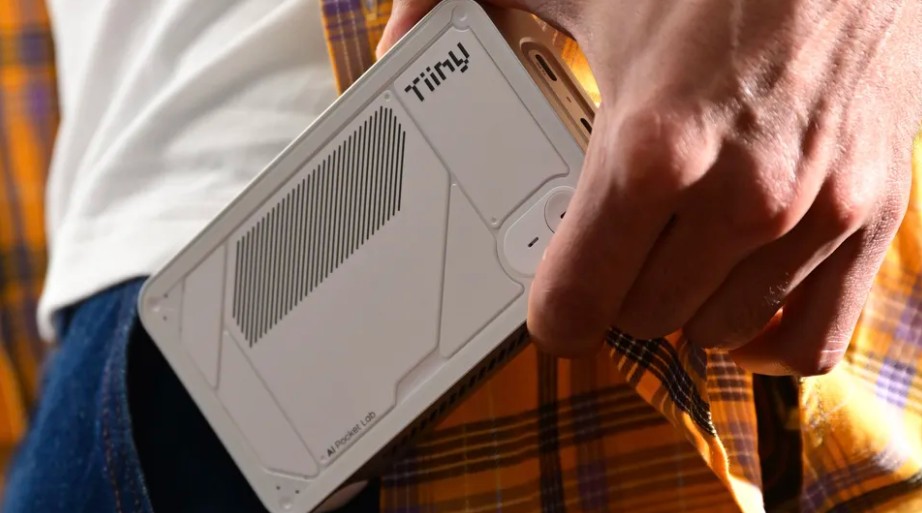
A new device billed as the world’s smallest AI supercomputer aims to shrink the capabilities of massive data-center systems into a machine small enough to fit in a pocket. Developed by the startup Tiiny AI, the handheld system, known as the AI Pocket Lab, demonstrates the rapid miniaturization of high-performance artificial intelligence hardware, tells Live Science.
The device is designed to run extremely large AI models locally rather than relying on cloud infrastructure. According to its creators, it can operate large language models containing up to 120 billion parameters, systems typically associated with powerful clusters of GPUs housed in data centers. Running these models locally allows the device to perform complex reasoning tasks such as advanced coding, document analysis, and multi-step problem solving without needing an internet connection.
Despite its small size, roughly comparable to a portable power bank, the system packs unusually powerful hardware. It uses a 12-core ARM processor paired with a specialized neural processing unit and includes around 80 gigabytes of high-speed LPDDR5X memory. This configuration delivers about 190 trillion operations per second of AI computing performance, placing it within the lower range of supercomputing capability while remaining highly portable.
Several engineering techniques enable such performance in a compact device. One key innovation is a method known as TurboSparse, which activates only the portions of an AI model required for each computation rather than running every parameter simultaneously. By reducing unnecessary processing, the system can execute extremely large models on far smaller hardware than traditionally required.
The emergence of miniature AI supercomputers reflects a broader shift toward edge computing. Instead of sending data to distant servers, powerful AI models can operate directly on local devices. This approach can improve privacy, reduce latency, and allow advanced AI tools to function in remote environments such as ships, aircraft, or research stations without reliable connectivity.
Although the pocket-sized machine cannot rival the world’s largest supercomputers, it represents a striking example of how rapidly artificial intelligence hardware is evolving. If such systems continue to shrink while maintaining performance, the future of AI may increasingly move from massive data centers into devices carried in everyday pockets.
