

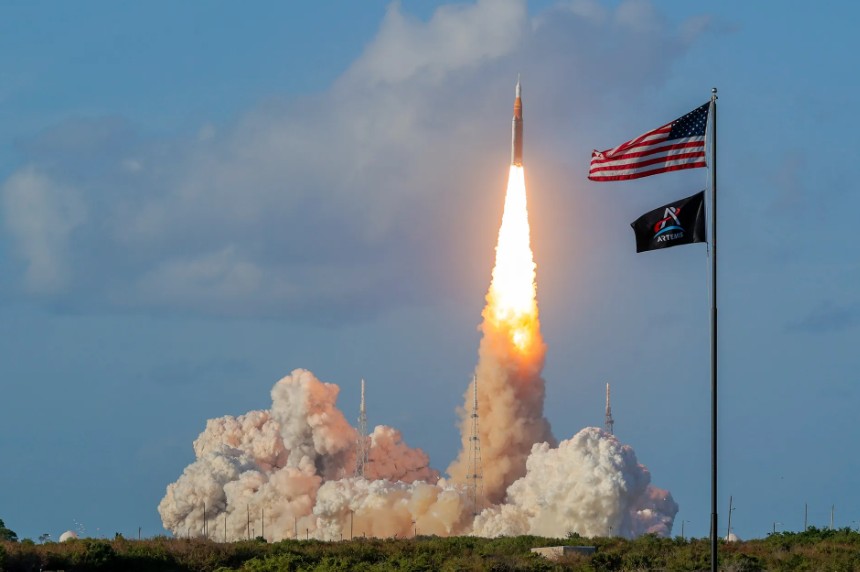
The trajectory of NASA’s Artemis II mission represents a carefully engineered balance between efficiency, safety, and mission objectives. Rather than taking a direct route to orbit the Moon, the Orion spacecraft follows a complex “free-return” path that loops around the Moon and naturally brings the crew back to Earth. This design minimizes risk while still allowing astronauts to travel deep into cislunar space, tells Wired.com.
After launch, Orion first spends time in a high Earth orbit, where systems are tested before committing to the journey outward. A critical engine burn then sends the spacecraft toward the Moon on a trajectory shaped by the gravitational interaction between Earth and its satellite. Unlike missions that enter lunar orbit, Artemis II performs a flyby, passing roughly 7,400 kilometers above the Moon’s surface.
The defining feature of the mission is its figure-eight trajectory. As Orion approaches the Moon, lunar gravity bends its path, effectively slingshotting the spacecraft back toward Earth. This maneuver eliminates the need for large propulsion burns on the return trip, conserving energy and reducing system complexity.
Engineers designed this path with redundancy in mind. Even if propulsion systems fail after the outbound journey, the spacecraft will still follow a natural course back to Earth. This passive return capability is a critical safety feature, echoing lessons learned from earlier Apollo missions.
Reentry is similarly planned with precision. Orion returns at high speed, relying on its trajectory and heat shield design to safely manage extreme thermal loads. The entire mission, lasting about 10 days, serves as a test of systems that will support future lunar landings.
The trajectory underscores a broader engineering principle: using gravitational forces as part of the design. By letting celestial mechanics do much of the work, Artemis II achieves a mission profile that is both efficient and inherently safer, marking a significant step forward in human spaceflight.
