

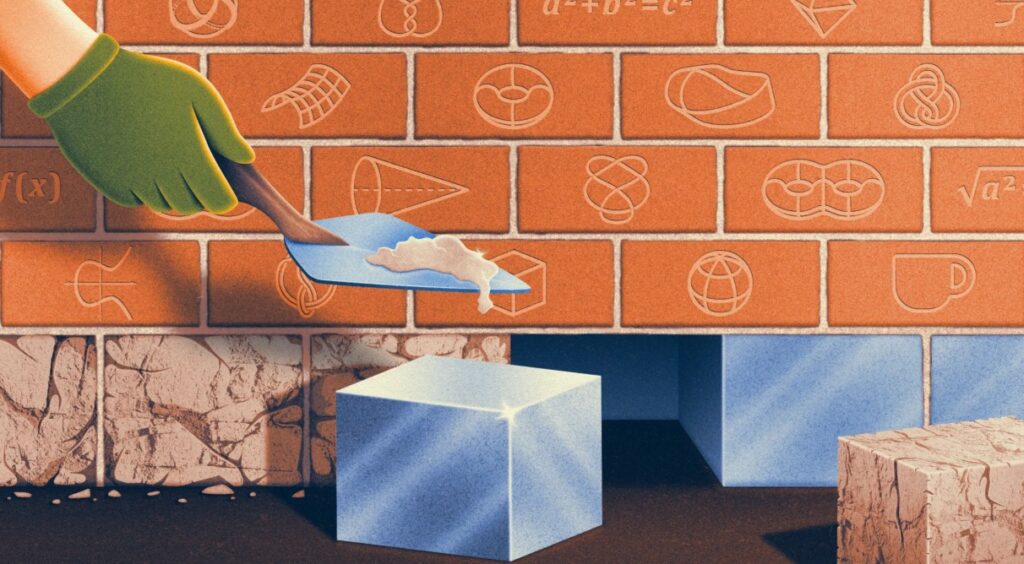
Mathematics is often viewed as one of humanity’s most stable intellectual systems, built carefully over centuries upon accepted logical foundations. Yet according to a recent Quanta Magazine article, two researchers are attempting something remarkably ambitious: reconstructing mathematics itself from an entirely different starting point. Their work challenges conventional assumptions about sets, objects, and the basic language mathematicians use to describe reality.
The researchers, David Jaz Myers and Mike Shulman, are working within an area known as category theory, a branch of mathematics that focuses less on individual objects and more on relationships and transformations between them. Traditional mathematics has long relied on set theory as its foundational framework, where everything is ultimately defined as collections of elements. Myers and Shulman argue that this approach can become cumbersome and disconnected from the structural patterns mathematicians actually study in practice.
Their alternative framework seeks to treat relationships and symmetries as more fundamental than isolated objects themselves. Rather than beginning with sets and building upward, the researchers aim to create foundations where connections, mappings, and transformations occupy the central role from the beginning. This perspective aligns more naturally with many modern mathematical fields, including topology, geometry, and theoretical physics.
A major influence on the project is homotopy type theory, an emerging field that blends ideas from algebraic topology, logic, and computer science. The framework also has implications for formal proof verification, where computers assist mathematicians in checking the correctness of complex proofs. By redesigning mathematical foundations in a way that better aligns with computational reasoning, the work could help bridge abstract mathematics and machine-assisted theorem proving.
The article emphasizes that the effort is not merely philosophical. Foundational systems influence how mathematicians organize knowledge, communicate ideas, and explore new theories. Supporters believe the emerging framework may eventually simplify difficult concepts and create more unified ways of understanding mathematical structures.
At the same time, replacing or reshaping centuries-old foundations is an enormous intellectual challenge. Set theory remains deeply embedded across modern mathematics. Even so, the researchers’ work reflects a broader pattern in contemporary mathematics: a growing recognition that relationships, transformations, and structures may reveal deeper truths than objects considered in isolation.
