

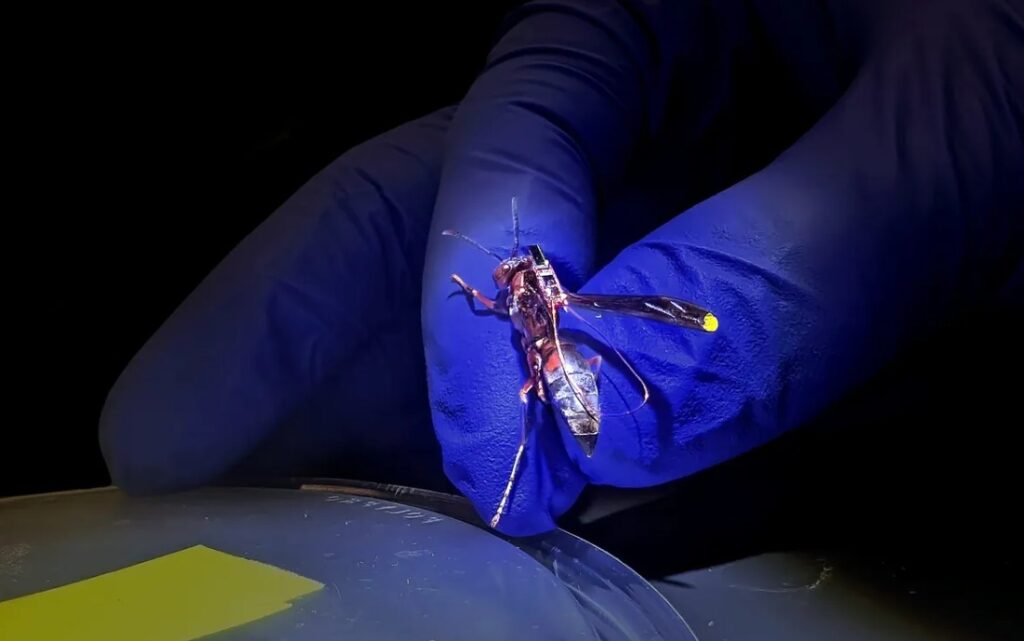
Scientists have developed an ultralight radio-frequency tracking tag designed to study the behavior of insects that are too small for conventional monitoring devices. The new tag, created by researchers at the University of Michigan, weighs just 20 milligrams, roughly one-third the weight of a drop of water. This miniature transmitter can be mounted on paper wasps, enabling scientists to track where the insects travel when they leave their nests, something that has been difficult to observe until now, tells IEEE Spectrum.
Insects such as wasps play important ecological roles as pollinators and predators of agricultural pests. Despite their importance, researchers still know surprisingly little about how these insects behave away from their nests. While scientists can observe wasps returning to their colonies, the details of their movements and interactions in the wider environment remain largely unknown. The new radio-frequency tag aims to fill this gap by providing a lightweight, nonintrusive way to track individual insects in real time.
Developing such a small tracker required several engineering innovations. Traditional tracking devices rely on batteries, which add weight and limit how small the system can be made. Instead, the Michigan team used a tiny photovoltaic array to harvest energy and charge a miniature capacitor. Once enough energy accumulates, the device sends a brief radio signal that can be detected from distances of up to 1.45 kilometers with positional accuracy of about 0.9 meters.
Engineers also had to ensure that the device did not disrupt the wasp’s flight. Paper wasps weigh roughly 125 milligrams and are capable of carrying heavy prey back to their nests, but the tag still needed to remain extremely light and aerodynamically unobtrusive. The researchers used CT scans of wasps to confirm that the device’s shape and placement would not interfere with the insect’s movement.
Early tests show promising results. After attaching the tag to a wasp, researchers tracked the insect as it flew rapidly out of sight, maintaining signal contact for more than a kilometer. Future experiments will examine the movements and social interactions of wasps during the warmer months when they are active.
Beyond insect research, the technology could inspire new ultralight tracking systems for other small animals. By combining energy-efficient electronics with miniature sensors, scientists may soon gain unprecedented insight into the hidden behaviors of some of the smallest creatures in the natural world.
