

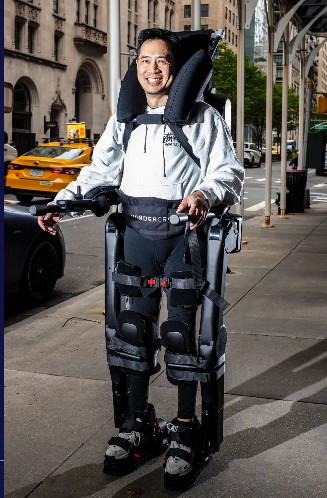
An IEEE Spectrum article centers on Robert Woo, a long-time exoskeleton user whose experience over 15 years has helped shape the evolution of wearable robotics. The article uses his journey to highlight a critical insight: exoskeleton development is as much about understanding the human user as it is about refining the machine.
Woo, who lost his ability to walk after an accident, has tested multiple exoskeleton systems, offering continuous feedback to engineers. His involvement underscores the complexity of designing devices that must work in close coordination with the human body. Unlike traditional robots, exoskeletons operate as part of a coupled system, where both the machine and the user influence each other’s behavior. Engineers can precisely measure the robot, but the human element remains far less predictable.
Over time, exoskeleton technology has progressed from bulky, lab-bound prototypes to more practical systems cleared for clinical and home use. Companies such as ReWalk and Ekso have brought devices to market, reflecting steady improvements in usability and reliability. Yet the article emphasizes that technical advances alone are insufficient. Real-world performance depends heavily on how comfortable, intuitive, and adaptable the systems are for users.
Woo’s feedback has driven refinements in balance, control, and mobility, helping engineers address challenges such as walking in everyday environments. Newer designs, including self-balancing systems, aim to reduce reliance on crutches and make movement more natural, bringing users closer to independent mobility.
The article ultimately frames exoskeleton development as an iterative, user-driven process. Continuous testing in real-life conditions reveals issues that cannot be captured in controlled environments. These insights feed back into design, improving both functionality and user experience.
Rather than a purely technological challenge, the future of exoskeletons depends on integrating engineering with human insight. By placing users such as Woo at the center of development, researchers are gradually transforming exoskeletons from experimental devices into practical tools that can restore mobility and independence.
