

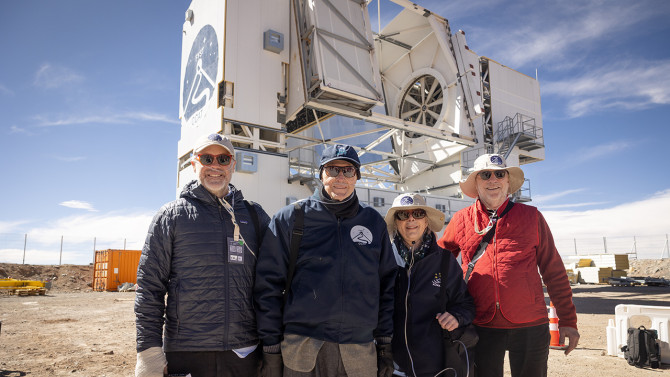
More than three decades after its conception, a powerful new observatory now stands atop one of Earth’s most extreme astronomical sites. The Fred Young Submillimeter Telescope (FYST), developed through an international collaboration led by Cornell University, has been inaugurated near the summit of Cerro Chajnantor in Chile’s Atacama Desert. At over 5,600 meters in elevation, the site offers exceptionally dry, thin air, ideal for capturing faint submillimeter wavelengths that are otherwise absorbed by atmospheric moisture, tells Cornell Chronicle.
FYST is designed to conduct wide-field surveys of the sky in submillimeter light, a region of the electromagnetic spectrum critical for studying cold cosmic phenomena. This includes the formation of galaxies, the behavior of interstellar dust, and signals from the early universe that remain invisible to optical telescopes. By scanning large swaths of the sky with high sensitivity, the instrument aims to generate detailed maps that can help scientists trace cosmic evolution over billions of years.
The telescope’s scientific goals extend to some of the most fundamental questions in cosmology. Researchers plan to use its observations to investigate dark matter and dark energy, which together make up most of the universe but remain poorly understood. It will also contribute to studies of the cosmic microwave background and the processes that followed the Big Bang, offering clues about the universe’s earliest structure.
Building and operating a telescope at such an altitude presents significant challenges. Personnel require supplemental oxygen, and equipment must withstand harsh environmental conditions. Yet these difficulties are outweighed by the scientific advantages. The Atacama region has become a global hub for astronomy precisely because its environment allows unprecedented observational clarity.
FYST represents a shift toward large-scale survey instruments that complement traditional telescopes focused on narrow targets. By combining breadth and sensitivity, it is expected to produce vast datasets that will support discoveries for years to come. As operations begin, the telescope opens a new observational window, bringing scientists closer to understanding the structure and origins of the universe.
