

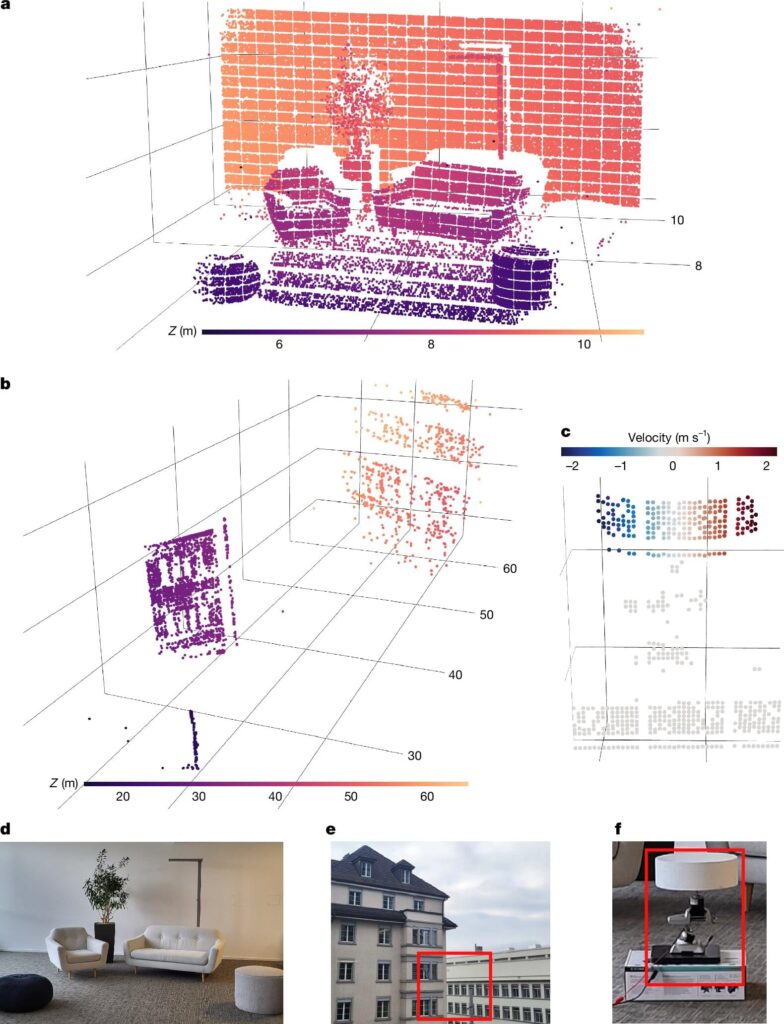
Researchers have developed a compact sensing chip that allows robots and autonomous machines to perceive their surroundings in four dimensions by measuring both the distance to objects and their speed at the same time, tells this article from Lifeboat Foundation. The innovation aims to overcome a key limitation in many robotic vision systems, which typically reconstruct the world in three dimensions but must rely on separate computations to estimate motion.
Traditional machine-vision systems used in robots and drones rely on cameras or lidar sensors to build 3D maps of the environment. While these technologies can accurately determine the shape and location of objects, they often struggle to track rapid movement or predict where objects will be next. Processing this information usually requires additional algorithms and computing resources, which can introduce delays in real-time decision-making.
The new chip addresses this problem by capturing both spatial and velocity information simultaneously. In effect, it gives machines a form of 4D perception, where the fourth dimension is time represented through motion. By integrating these measurements directly into the hardware, the system can detect moving objects and estimate their trajectories almost instantly.
This capability is especially important for robots operating in dynamic environments. Autonomous drones, delivery robots, and self-driving vehicles must constantly evaluate moving obstacles such as people, vehicles, or other robots. Faster motion tracking allows machines to react more quickly, improving safety and reliability during navigation or manipulation tasks.
Another advantage is efficiency. Because the chip performs much of the processing at the sensor level, it reduces the computational burden on the robot’s central processor. That could lower energy consumption and enable smaller, lighter robotic systems capable of sophisticated perception without large onboard computers.
The technology could ultimately enhance a wide range of applications, from autonomous vehicles and industrial robots to drones and smart sensing systems. By combining distance measurement with real-time motion detection in a single device, the chip represents a step toward machines that perceive the world with greater awareness and responsiveness.
