

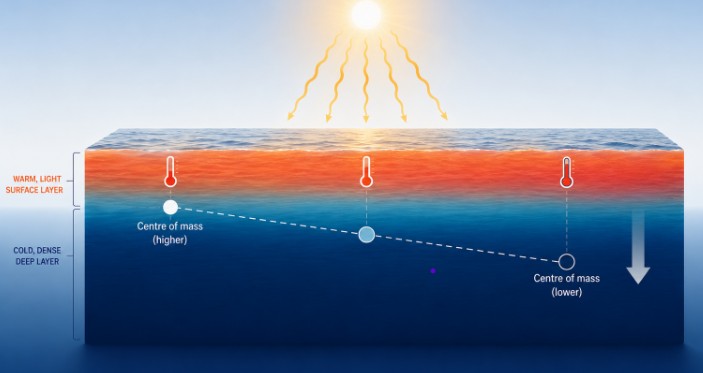
A new study from the University of Gothenburg reveals that global warming is steadily changing the internal structure of the world’s oceans. Researchers found that rising temperatures in surface waters are increasing ocean stratification, a process in which lighter warm water remains near the surface while denser cold water sinks deeper. This shift is effectively altering the ocean’s center of mass and disrupting the natural mixing that marine systems depend on.
The research introduces a new method for studying ocean stratification by measuring where most of the ocean’s mass is concentrated vertically. According to lead author Fabien Roquet, the findings show a clear and persistent trend linked directly to climate change. As oceans absorb more atmospheric heat, their upper layers warm and stabilize, reducing the circulation between surface and deep waters.
The consequences extend far beyond temperature changes alone. Reduced vertical mixing limits the ocean’s ability to absorb heat and carbon dioxide because surface waters are no longer transported efficiently into deeper layers. At the same time, nutrient-rich deep water struggles to rise toward the surface, threatening marine ecosystems and food chains that depend on those nutrients. Scientists warn that these changes could also influence oxygen levels, biogeochemical cycles, and major ocean current systems.
The study identified especially strong stratification increases in the tropical Pacific and Indian Oceans, western boundary current systems, and the Arctic. However, researchers observed an unexpected weakening of stratification in parts of the subpolar North Atlantic. This finding challenges assumptions about the imminent collapse of the Atlantic Meridional Overturning Circulation, or AMOC, which includes the Gulf Stream.
The article ultimately frames ocean stratification as one of the clearest physical signals of accelerating climate change. By reshaping the ocean’s internal balance, warming waters are not only altering marine ecosystems but also weakening one of Earth’s most important systems for regulating heat and carbon.
