

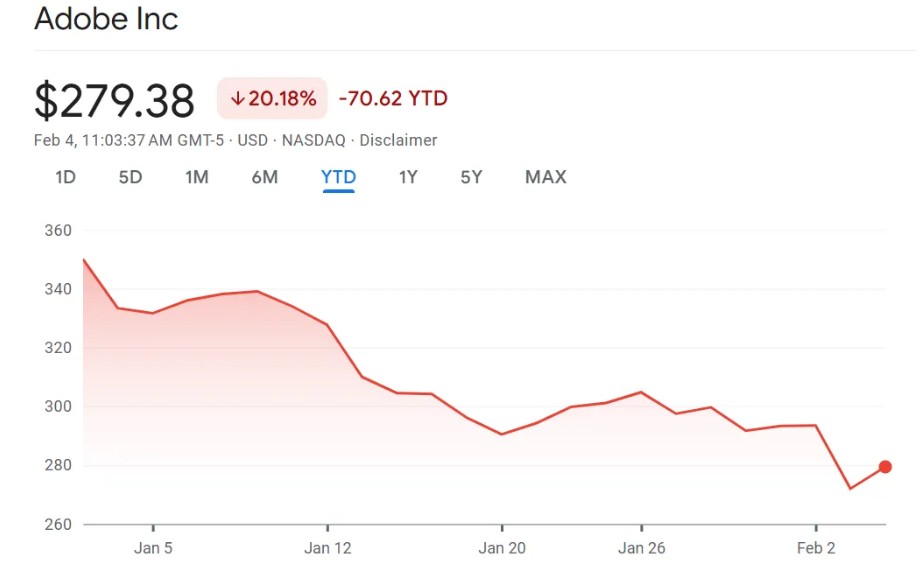
Financial analysts are more bearish on Adobe than at any point since 2013. Its shares have fallen about 20% since the start of the year and now trade at less than half their peak. Downgrades reflect skepticism that the stock will rebound soon, dampening investor demand.
WorldCAD Access points out that the concern is not enterprise AI that promises productivity gains, but generative AI that produces low-quality text, images, music, video, and even code. This flood of passable, low-effort output, often called slop, may be good enough for casual uses such as quick illustrations or background visuals. If users can prompt an AI system to generate acceptable graphics instantly, they may feel less need to purchase and master professional tools such as Photoshop or Illustrator.
Adobe is not alone. A range of SaaS companies have seen share prices decline this year, including SAP, Microsoft, Workday, Oracle, Salesforce, ServiceNow, and DocuSign. Over the past decade, many software vendors shifted from perpetual licenses to subscription models, ensuring recurring revenue. Now Wall Street is applying a new thesis: AI eats software. If generative models can deliver in seconds what teams once produced using specialized tools, the number of paid software seats could shrink.
Some observers speculate about a shift from per-seat pricing to per-outcome pricing, where customers pay for results rather than user licenses. Today, many AI services are free or low cost, undercutting subscription fees such as Adobe’s monthly charge for Photoshop or Autodesk’s higher fee for AutoCAD.
Yet precision distinguishes design and engineering software from creative graphics. CAD and CAM demand exact dimensions; minor errors can lead to costly or dangerous outcomes. Code also requires strict accuracy. While AI may assist with suggestions or rendering, core engineering tasks cannot tolerate slop.
Despite falling shares among some U.S. CAD vendors, the long-term threat remains uncertain. If generative AI proves overhyped and financially unsustainable, traditional SaaS models could stabilize once the current market anxiety subsides.
