

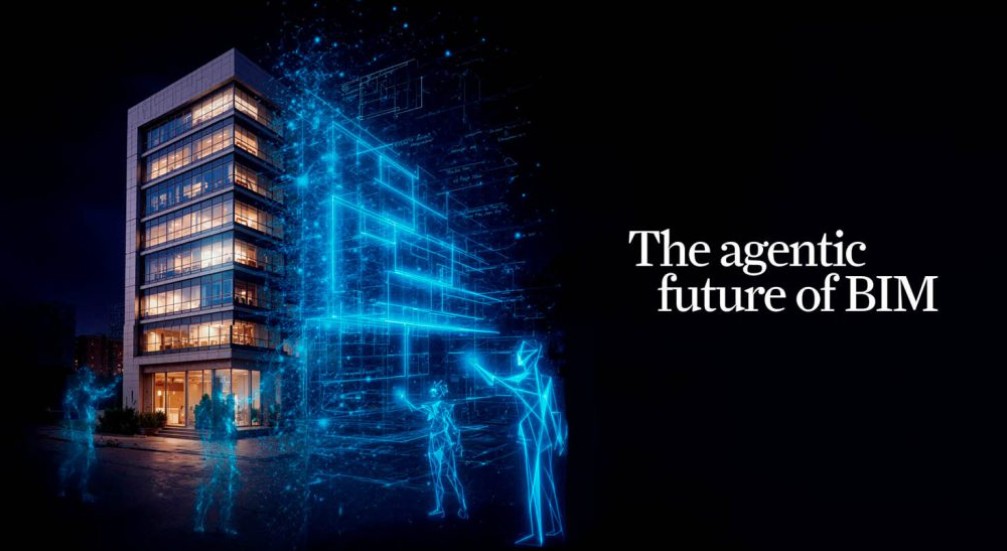
Building Information Modeling (BIM) has evolved gradually over decades, but the rise of artificial intelligence may trigger a far more disruptive shift. In this AEC Magazine article, Martyn Day argues that the next phase of BIM will be shaped by “agentic” AI systems capable of generating, evaluating, and orchestrating design decisions rather than simply documenting them. According to the article, solver-driven design tools powered by AI could significantly reshape architecture, engineering, and construction workflows within the next five years.
Historically, BIM replaced physical drawings with digital models and structured project data. While this transformation improved coordination across disciplines, many existing tools remain constrained by file-based workflows, performance limitations with large models, and incremental productivity gains. These limitations have encouraged a new wave of startups to rethink BIM from the ground up. Instead of recreating traditional modeling tools with better collaboration features, developers are exploring what a BIM platform should look like in an AI-driven environment.
One emerging concept treats BIM as an “operating system” for the built environment. In this vision, BIM becomes a structured data layer that connects human intent with machine execution. AI agents and generative solvers could operate on this layer to produce geometry, evaluate design constraints, and coordinate complex project data automatically. As a result, the role of BIM may shift from a modeling application to a live runtime environment where information is continuously processed and optimized.
This transformation also challenges the dominance of established BIM platforms such as Revit and Archicad. While these tools contain decades of industry knowledge, they must adapt to a world where increasing amounts of geometry and design logic may be generated by algorithms rather than manually authored by designers. To remain relevant, BIM systems will likely need to open their architectures, integrate generative engines, and treat project data as an active computational resource instead of a static file.
Ultimately, the agentic future of BIM points toward design environments where intelligent systems collaborate with human professionals. In such workflows, architects and engineers may focus less on drawing models and more on guiding AI-driven processes that compute, analyze, and refine buildings in real time.
